
Why it matters
The producer
Cantina Tonello sits in Montorso Vicentino, at the base of the Monti Lessini in the Chiampo Valley east of Verona. Antonio Tonello founded the estate formally in 1985, though the family's hold on these volcanic hills goes back to his great-grandfather Giovanni, who worked the land in the 1930s. Antonio took the decision that defined everything that followed: to bottle wine under the family name rather than sell the harvest in bulk. Twelve hectares farmed organically, two named parcels, and a production focused on sparkling wines from Durella, the ancient indigenous vine of the Lessini range. His daughter Diletta, holding a doctorate in Viticultural and Oenological Sciences, joined in 2014 and has carried the estate outward into international markets. In 2022 she was elected President of the Lessini Durello Consorzio, the governing body for the appellation.
This is not Soave. It is not Valpolicella. It is a small organic estate in a corner of the Veneto built around one ancient grape on basalt soils formed fifty million years ago, producing sparkling wines that taste of mineral, salt, and volcanic ground.
Place and vineyards
Where the wines begin
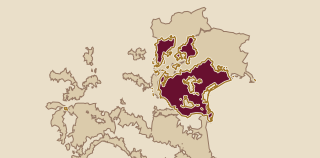
The Monti Lessini rise north of Verona into a plateau of dark volcanic rock. The mountains formed approximately 50 million years ago when rising magma broke through the earth and cooled into basalt and tuff. Soils here hold iron and mineral compounds that still mark the wines: the acidity reads as structural and tight rather than fruity, the finish as stony and saline rather than soft. Montorso Vicentino and the Chiampo Valley sit at the foothills of this plateau, cooler and higher than the plains below, where the elevation preserves natural acidity in the grapes through a longer growing season.
The appellation for Marachelle is IGT Veneto rather than Lessini Durello DOC, giving the estate latitude to blend Durella with Chardonnay without restriction.
In the cellar
Vineyards and cellar
The 12 hectares are farmed organically across the volcanic soils of the Chiampo Valley. Durella is the primary variety, planted for its thick skins, high natural acidity, and strong affinity with the basalt terrain. Garganega grows alongside Durella and contributes to blended wines in the range. The organic approach, applied across the whole estate, avoids synthetic inputs and works with the volcanic soil's natural mineral composition rather than correcting it.
Marachelle, the estate's anchor sparkling wine, undergoes second fermentation in bottle with a minimum of three months in contact with the sediment before release. The wine is not disgorged: the sediment remains in the bottle at the point of sale, placing it within the col fondo tradition. This method, older than the Champagne process and historically common in the Veneto, preserves a faint cloudiness and a yeasty texture alongside the grape's primary fruit character. Alcohol sits at 11%, acidity at 6.00 g/l.
Wines to know
The range in view
The range centres on Durella in sparkling form, with Garganega contributing to still and blended wines. Marachelle is the estate's most visible bottle: a non-vintage blend of Durella and Chardonnay, classified IGT Veneto, made col fondo. It carries the grape's full acidity at 11% alcohol, giving a wine that is light, fizzing, and mineral with a round mid-palate from the sediment contact. The col fondo process adds a faint cloudy texture and a subtle breadiness that sits beneath the fruit.
The two named parcels, Chiampo and Agugliana, indicate a terroir-focused direction in the range, though specific bottlings from these parcels are not detailed in the confirmed source material. The estate's broader output includes still wines from Garganega and Durella, though Marachelle and the sparkling range represent the house's clearest statement.
A useful way in
A bottle to begin with
Marachelle NV. This is a Durella and Chardonnay col fondo sparkling wine at 11% alcohol, made in Montorso Vicentino on fifty-million-year-old volcanic soils and released with sediment in the bottle. Pour it gently and expect a faint cloudiness: that cloudiness is the second fermentation working without disgorgement, the natural wine tradition of the Veneto rather than a fault. On the nose, pear, orange, and ginger. In the mouth, firm and mineral with zippy mousse, a round mid-palate, and a clean saline close. The alcohol is low, the acidity is high, and the texture is both lively and quietly fleshy.