
Why it matters
The producer
Cantina Valle Isarco farms some of the highest vineyard ground in Italian wine. Headquartered in Chiusa, a small town in the Valle Isarco subzone of Alto Adige, the cooperative was founded in 1961 and remains the youngest of South Tyrol's cooperative wineries. Its 135 members hold parcels across 11 municipalities, with elevations reaching 1,000 metres above sea level. That ceiling is unusual for Italy, and it shapes everything the cooperative produces.
Ninety-eight percent of output is white. Sylvaner, Kerner, Müller Thurgau, and Grüne Veltliner are the four varieties that define the range. Sylvaner has been cultivated in the valley for over a century; it is the cooperative's anchor variety. Lagrein and Pinot Noir exist in the range but occupy the margins. The cooperative's story is built on aromatic, mineral-driven Alpine whites, and the bottle profile follows from that.
Place and vineyards
Where the wines begin
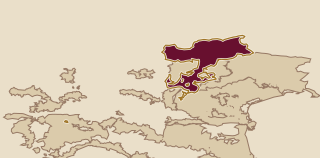
Vallee Isarco is a north-south valley carved by the Eisack River, running from the Brenner Pass south toward Bolzano. The valley is narrow, steep-sided, and cold. Vineyards cling to the slopes at angles that make mechanisation difficult; hand-harvesting is common across the elevation band.
The altitude range from 250 to 1,000 metres creates a wide thermal gap between day and night temperatures, particularly in the growing season. That gap preserves aromatic compounds in the grapes and keeps acidity high through ripening. The Ora, a warm wind that moves north from Lake Garda during afternoon hours, moderates what would otherwise be a harshly cool climate, allowing full phenolic development without losing the freshness the elevation provides. The result in the glass is wines that are aromatic and lifted, with a mineral quality that comes from the combination of cool nights, altitude, and the valley's primarily silicate and sandy soils.
In the cellar
Vineyards and cellar
The 135 members farm their own parcels and deliver fruit to the cooperative's cellar in Chiusa. Vineyard access across the elevation band means harvest timing is staggered across the season: lower parcels come in earlier, higher parcels later. Hand-picking is standard on the steeper sites.
In the cellar, the core white range is handled to preserve primary fruit and acidity: cool fermentation, stainless steel for most bottlings. The granite tank Kerner introduced a different approach, using an inert but porous vessel to allow very slow micro-oxygenation without adding wood character. Granite neither heats nor flavours; it allows the wine to breathe at a rate slower than steel but without the vanilla, spice, or tannin extract that comes from oak contact.
Wines to know
The range in view
Sylvaner is the entry point and the anchor. It appears in the standard tier as a valley-floor and mid-slope white with a greenish-yellow colour, stone-fruit aromas of peach, apple, and apricot, a mineral backbone, and a clean finish. It is dry, aromatic, and light-bodied.
Kerner is the valley's other signature white. More aromatic than Sylvaner, with higher natural acidity, it is vinified both in stainless steel for the standard tier and in the 960-litre granite tank for the Cotarella project cuvée. The granite-tank version is intended for a drinker who wants the aromatic intensity of Kerner without any wood influence.
A useful way in
A bottle to begin with
Start with the Sylvaner. It is the grape that has defined the valley for over a century, the cooperative's anchor variety, and the wine that most directly answers the question of what high-altitude Alto Adige tastes like. The 2020 bottling poured bright greenish-yellow, with peach, apple, and apricot on the nose and a mineral backbone that carries through the finish. It is dry, clean, and light enough to drink easily, but specific enough to teach something. Buy it cold, drink it with food that has some acidity of its own, and you will understand why 135 farmers in a steep Alpine valley decided to stake almost everything on white wine.