
Why it matters
The producer
Cantine Colomba Bianca makes its argument from scale, not rarity. Nearly 2,500 member growers farm more than 1,800 certified organic hectares across the Trapani province of western Sicily, feeding six facilities that handle everything from fermentation to bottling. The cooperative's total cellar capacity exceeds 14 million litres. Those numbers are not decoration. They are the foundation of what Colomba Bianca actually does: coordinate large-scale organic viticulture across western Sicily and turn it into consistent single-varietal whites that hold their own at international competition.
The cooperative was founded in 1970 and began transforming its own grapes at the Tre Cupole facility in 1980. It grows over 32 varieties, both autochthonous Sicilian and international. The core commercial work sits in the Vitese range, where the Zibibbo bottling has collected gold medals at Mundus Vini, Concours Mondial Bruxelles, and Berliner Wein Trophy in successive recent years.
Place and vineyards
Where the wines begin
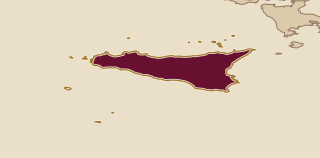
Mazara del Vallo sits on the southwestern coast of Sicily, in the Trapani province, a few kilometres from the Strait of Sicily where the Mediterranean narrows toward Tunisia. This is western Sicilian wine country, distinct from the Etna-focused eastern half of the island that now draws most international attention. The western province is broader, flatter, and hotter than the volcanic northeast. The Mediterranean climate here is dry and wind-driven, with long growing seasons that push grapes toward full aromatic development. Zibibbo, the key aromatic variety, has deep roots in this part of Sicily: it was brought to the island centuries ago and has adapted to the warm, dry conditions of the western coast, where it produces intensely perfumed grapes even at cooperative scale.
The Trapani province label appears on Colomba Bianca bottles rather than a single village or cru designation, reflecting the cooperative model: member parcels are spread across the territory rather than concentrated on one estate.
In the cellar
Vineyards and cellar
Farming across 2,480 member holdings is standardised through the cooperative's traceability model, which applies unified quality standards from vineyard management through to bottling. Organic certification covers more than 1,800 hectares, meaning the majority of Colomba Bianca's grapes are grown without synthetic pesticides or herbicides. Five of the cooperative's six facilities are dedicated to winemaking; the sixth handles bottling exclusively. This separation allows fermentation, stabilisation, and ageing to happen at winery sites close to the vineyards before the finished wine moves to a centralised bottling line.
Zibibbo is harvested when the aromatic compounds in the thick skins reach full development, which in western Sicily's hot, dry climate typically means a late-summer pick timed for freshness rather than maximum sugar. The resulting wine is pressed gently to preserve the floral and citrus character in the grape's aromatic fraction.
Wines to know
The range in view
The Vitese range is Colomba Bianca's primary single-varietal line. The Vitese Zibibbo is made from Zibibbo, the Sicilian name for Muscat d'Alexandrie, a thick-skinned, intensely aromatic white grape with a long history in the warm western islands of the Mediterranean. In the glass it is straw-yellow and limpid, with citrus and stone fruit on the nose: lemon and cedar up front, then apricot and pineapple, with orange blossom and jasmine underneath. On the palate, acidity and a soft residual sweetness run alongside each other, giving the wine a sapid, moreish character instead of a straightforwardly dry finish. It is not a heavy wine despite the warm-climate grape: the aromatic lift is the point.
The Crudo line offers a different architecture. Crudo Catarratto Zibibbo blends Catarratto, a high-acid native Sicilian white variety, with Zibibbo, pairing the structural freshness of Catarratto with Zibibbo's aromatic weight. The blend is organic and appears in export markets including the Swedish state retail network. No further range positions are confirmed in verified sources.
A useful way in
A bottle to begin with
Start with Vitese Zibibbo. Zibibbo is Muscat d'Alexandrie under a Sicilian name, and this bottling shows what the grape produces in western Sicily's hot, dry climate: intense orange blossom, lemon, apricot, and jasmine rising from the glass, with soft acidity and a low residual sweetness that keeps the palate lively. It is made from Zibibbo, the Sicilian name for Muscat d'Alexandrie. Gold medals at three international competitions in two years suggest the consistency is real. A single bottle makes the cooperative's aromatic argument more clearly than any description of its scale.