
Why it matters
The producer
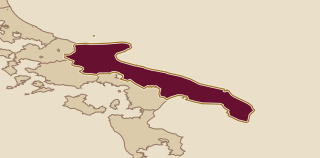
Cantine Coppi farms 200 hectares of indigenous Puglian vines across southeastern Italy, from the limestone hills south of Bari down to the flatter, hotter terrain of the Salento peninsula. The estate bottles exclusively from autochthonous varieties: Primitivo, Negroamaro, Aleatico, Falanghina, Malvasia Bianca, and Malvasia Nera. No international grapes enter the range.
The winery was founded in 1882 by an Apulian winemaker who left no name in the public record. For nearly a century it remained a bulk producer, its wine leaving the property in tank and barrel without a label. In 1979, Antonio Coppi took over and made the transformation of the winery his life's project. In the early 1990s, he purchased the first bottling line. That purchase is the moment the estate became what it is today: a named, branded, estate-bottled Puglian producer at significant scale.
Place and vineyards
Where the wines begin
The Gioia del Colle DOC sits on the Murge plateau, the limestone upland that rises south of Bari before the land flattens toward the Salento coast. At elevation, the nights are cooler, the soils have more limestone, and Primitivo ripens with more acidity than it typically does in the deeper, hotter ground of Salento. The DOC designation on a Coppi Primitivo is a geographic claim: these are hill grapes, not coastal plain grapes, and the label reflects a legal boundary that enforces that distinction.
The IGP Puglia and IGP Salento designations cover the wider estate holdings and allow the full varietal range, including the Malvasia Bianca and Negroamaro that make up the Serralto and Pellirosso bottles. Salento is the southern peninsula; its terroir is warmer and lower-lying, which shapes the fuller, softer character of the Negroamaro in particular.
In the cellar
Vineyards and cellar
All 200 hectares are farmed with what the estate describes as meticulous care, managed in-house across both owned and rented parcels. The commitment to indigenous varieties shapes every choice from the vine outward: the range covers six Puglian grape families, each vinified to express its own character.
The most technically specific process in the cellar is the vinification of Don Antonio Primitivo. After harvest, the grapes undergo carbonic maceration for seven to eight days, a method that draws colour and primary fruit from the grapes without the extended skin contact and tannin extraction of conventional red winemaking. The wine then undergoes malolactic fermentation in large 100-hectoliter Slavonian oak barrels. The Slavonian oak is traditional, porous, and mild in flavour impact; the large barrel size limits the oak-to-wine ratio, so the wood adds subtle spice and soft texture without dominating the fruit.
Wines to know
The range in view
The Coppi range covers whites, reds, and dessert styles, all built from indigenous varieties.
Serralto Malvasia Bianca IGP Puglia is 100% Malvasia Bianca, fermented cold in stainless steel. The grape produces a bright golden yellow wine with aromas of white peach, apple blossom, and floral notes. On the palate it is full and fruity with a thread of fresh acidity running through a discreet residual sweetness, giving the wine an unusual width for a white from this region.
A useful way in
A bottle to begin with
Don Antonio Primitivo IGP Puglia is the bottle that shows what Coppi is doing differently. It is 100% Primitivo, fermented by carbonic maceration for seven to eight days and then moved into large Slavonian oak barrels for malolactic fermentation. The technique separates this wine from standard Puglian Primitivo, which is typically fermented with extended skin contact and comes out dense, tannic, and high in alcohol. Don Antonio is still a full southern red, but the carbonic maceration extracts colour and ripe fruit ahead of grip. It is intense and dark-fruited on the nose, with spice from the oak, and fresher on the palate than the grape's southern origin would suggest.