
Why it matters
The producer
In 2021, Cantine di Verona s.c.a. was born from the merger of three wineries, Cantina Valpantena, Cantina di Custoza, and Cantina Colli Morenici. Cantine di Verona s.c.a. manages approximately 1,800 hectares of vineyards across the Valpolicella and Lake Garda zones.
The scale is large. Annual production runs to approximately 800,000 nine-liter cases. The Lucia De Maio label, the cooperative's premium tier, uses appassimento-dried Corvina for Amarone, extended Slavonian oak aging, and a Ripasso made from the same core varieties with a silkier, more accessible profile.
Place and vineyards
Where the wines begin
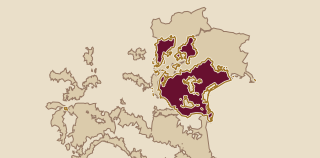
The Valpolicella zone sits in the hills northeast of Verona, where basalt, limestone, and clay soils support the red grape varieties that define the region. Corvina is the dominant grape, grown on terraced hillside plots at elevations that slow ripening and preserve acidity. Lucia De Maio Amarone and Ripasso are made from Corvina, Corvinone, and Rondinella in varying ratios.
To the west, the Lake Garda shoreline produces a different wine entirely. Custoza DOC is white wine territory, produced on soils shaped by glacial moraine that moderate temperature and extend the growing season. The lake moderates temperature and extends the growing season. Custoza remains part of the cooperative's regional wine range.
In the cellar
Vineyards and cellar
The cooperative manages approximately 1,800 hectares of vineyards across the Valpolicella and Garda zones. Member growers bring their harvests to the cooperative for vinification, and the cooperative's cellar team makes the final decisions on blending, drying protocol, and barrel selection for each tier.
For the Lucia De Maio Amarone, the process begins at harvest with selective picking of Corvina, Corvinone, and Rondinella. The grapes move to ventilated lofts, the fruttai, where they dry for 100 to 120 days. During this period, water evaporates from the berry, concentrating sugars, acids, and aromatic compounds. By the time the dried fruit reaches the fermentation vessel, the grape has already become something different from what was picked: denser, sweeter, with a different aromatic profile than fresh Corvina. Fermentation runs slowly on this concentrated material, pushing alcohol to 15 percent.
Wines to know
The range in view
The Lucia De Maio Amarone della Valpolicella DOCG is the top of the range. The 2022 vintage uses 70 percent Corvina, 15 percent Corvinone, and 10 percent Rondinella, bottled at 15 percent alcohol after 100 to 120 days of appassimento drying and 24 to 30 months of barrel aging. This is a wine built for time: optimal between five and eight years from harvest, with aging potential through 15 to 20 years.
The Lucia De Maio Ripasso DOC sits one step below. The 2023 uses 70 percent Corvina, 15 percent Corvinone, and 15 percent Rondinella. Ripasso refers to a specific winemaking method: Valpolicella wine is repassed over the pressed skins of Amarone, which triggers a secondary fermentation and adds body, color, and dried-fruit character to what began as a lighter red. The wine has medium body, silky texture, and bright acidity, carrying flavors of cherry, ripe strawberry, blood orange, cinnamon, sage, and oak. Softer tannins than Amarone, lower alcohol, and a more approachable profile make it a practical entry into the Valpolicella hierarchy.
A useful way in
A bottle to begin with
The Lucia De Maio Ripasso DOC 2023 is made from 70 percent Corvina, 15 percent Corvinone, and 15 percent Rondinella. It makes the cooperative's winemaking logic accessible before committing to the patience that Amarone requires. The Ripasso method produces a wine that already shows the dried-fruit character of the Valpolicella hierarchy, specifically the concentrated cherry and spice of Corvina after contact with Amarone skins, without the density or the ten-year cellaring arc of the full Amarone. Medium body, silky texture, bright acidity, soft tannins, and a flavor range that covers cherry, strawberry, blood orange, cinnamon, and sage.