
Why it matters
The producer
Angelo Maci founded Cantine Due Palme in Cellino San Marco in 1989 by consolidating three older local cooperatives, one established as far back as 1955, into a single organisation. His logic was direct: he articulated it in a phrase that still defines the cooperative today, that winning alone is possible but winning together is better. What he built over the following three decades was one of southern Italy's larger cooperative operations, drawing on 1,000 member winegrowers farming approximately 2,500 hectares across the provinces of Brindisi, Taranto and Lecce.
The wine that carries Due Palme's name externally is Selvarossa, a Salice Salentino Riserva made from Negroamaro and Malvasia Nera. Gambero Rosso awarded it Tre Bicchieri for the 2019 vintage, its highest recognition tier. A cooperative processing 250,000 quintals of grapes annually across two production centres is an industrial operation by volume; what keeps Selvarossa credible at that scale is the farming beneath it.
Place and vineyards
Where the wines begin
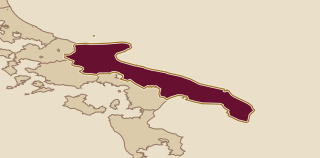
The Salento peninsula is the southernmost part of Puglia, the long narrow region that forms the heel of Italy's boot. It is flat, sun-baked, and surrounded on three sides by sea: the Adriatic to the east, the Ionian to the west and south. Temperatures in July and August regularly exceed 35 degrees Celsius. Rainfall is low and concentrated in winter. The coastal influence moderates the heat slightly and keeps humidity in check through summer.
Negroamaro is the grape native to this landscape. In that heat, it ripens fully and produces wine with deep colour, substantial body, and a characteristic profile: earthy, herbal and spicy alongside ripe dark fruit. The Salice Salentino DOC occupies a zone within the Salento sub-region, straddling the provinces of Brindisi and Lecce, and it is built around Negroamaro as its primary grape. Riserva wines must meet minimum ageing requirements under DOC rules before release, which pushes the fruit character toward greater depth and integration.
In the cellar
Vineyards and cellar
Due Palme draws grapes from approximately 2,500 hectares of member vineyards spread across Brindisi, Taranto and Lecce. The cooperative processes around 250,000 quintals of grapes each year across two production centres. Member vineyards are trained in alberello, the low bush-vine system that forces hand harvesting and concentrates the vine's output into a smaller crop per plant. In the sustained heat of a Salento growing season, that concentration builds ripe, dark fruit with the tannin depth that Negroamaro carries when fully matured.
Selvarossa is barrel-aged before release as a Riserva. Blend percentages for Negroamaro and Malvasia Nera in Selvarossa are not confirmed.
Wines to know
The range in view
Due Palme's portfolio covers twenty-five wines drawing on Puglian appellations across the three provinces. Salice Salentino DOC is the appellation at the top of the range, and Selvarossa sits at the top of that appellation tier.
Selvarossa is a Salice Salentino Riserva DOC built on Negroamaro with Malvasia Nera. The nose carries toasted notes, sweet spices and black fruits; the palate is compact and rich in fruit with a long finish. The 2019 Riserva was described by Gambero Rosso as rich, deep, harmonious and articulated, earning Tre Bicchieri. The 2020 Riserva drew the same reviewers toward a well-crafted, modern character with a Mediterranean quality to the fruit. Across both vintages the wine presents the earthy, herbal and spicy baseline that Negroamaro produces in the Salento heat, deepened by barrel ageing and the Riserva minimum.
A useful way in
A bottle to begin with
Selvarossa Salice Salentino Riserva DOC is the right first bottle. It is Negroamaro and Malvasia Nera from Salento's hottest growing zone, barrel-aged to Riserva standard, and it carries everything the cooperative's member vineyards produce: dark fruit ripeness, earthy spice, toasted depth on the nose, and a palate that is compact and long-finishing. The wine is full-bodied and warm, with tannins that are firm but not hard. Start here and you have the grape, the appellation, the cooperative's farming philosophy and its critical standing in one glass.