
Why it matters
The producer
Cantine Ermes farms more certified organic vineyard land than most Sicilian producers manage in total. The cooperative, founded in 1998 in the Belice Valley of western Sicily, brings together 2,832 member-growers across approximately 16,764 hectares. Its headquarters sit between the communes of Gibellina and Santa Ninfa, and its range covers both indigenous Sicilian varieties and international grapes.
The scale is real. But the more precise description of Cantine Ermes is this: a cooperative that formed thirty years after the 1968 Belice earthquake as a vehicle for the valley's agricultural recovery, and that still farms the vineyards surrounding one of the largest land artworks in the world.
Place and vineyards
Where the wines begin
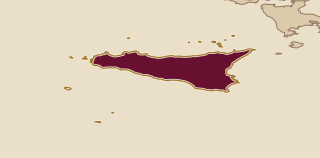
The Belice Valley runs through the interior of western Sicily, a zone of low hills, clay-limestone soils, and dry Mediterranean summers. The valley sits inland from the Sicilian channel coast, sheltered enough to accumulate heat through the growing season and open enough to wind to slow ripening on exposed slopes. Nero d'Avola, Sicily's most planted and best-known red variety, thrives in this warmth. It delivers deep colour, plum and dark cherry fruit, and firm tannin when farmed on well-drained sites.
The valley is also earthquake country. The 1968 Belice earthquake killed over 200 people, destroyed multiple towns outright, and reshaped the agricultural landscape for decades. Gibellina, one of the worst-affected communes, was rebuilt in a new location several kilometres from the original site. The ruins of Gibellina Vecchia, the old town, remained.
In the cellar
Vineyards and cellar
The cooperative's 3,118 certified organic hectares are farmed without synthetic herbicides, pesticides, or chemical fertilisers. Natural fertilisation keeps soil biology active across the growing season.
Cellar protocols for individual wines are not fully disclosed, but the range architecture suggests separate vinification by grape and label. Buccia Sicilia is made entirely from Nero d'Avola, kept as a single-variety expression. Ca' Nomboli Prosecco DOC Extra Dry is made from Glera and follows Prosecco DOC production rules, with secondary fermentation in tank to preserve freshness and delicate perlage.
Wines to know
The range in view
Cantine Ermes produces a wide portfolio across indigenous and international grape varieties. Two labels anchor the range.
Buccia Sicilia is the Nero d'Avola expression. Made from 100% Nero d'Avola, it carries the deep colour, plum fruit, and firm tannin typical of the variety on warm inland Sicilian soils. Ca' Nomboli Prosecco DOC Extra Dry is made from Glera, the grape behind all DOC Prosecco, and is produced as a sparkling wine with pale straw yellow colour and greenish highlights. The perlage is fine and persistent. The fruit register sits in the peach and apple range, with the off-dry profile of an Extra Dry dosage level.
A useful way in
A bottle to begin with
Buccia Sicilia is the right first bottle. It is made from 100% Nero d'Avola, the grape the Belice Valley grows best, and it shows what the cooperative's certified organic farming produces from warm inland Sicilian ground: deep colour, plum and dark cherry fruit, firm but not aggressive tannin, and a dry finish with some earthy length. No blending, no decoration. One variety, one valley, one bottle. Order it with a grilled lamb chop or a plate of aged sheep's cheese and it becomes immediately clear why Nero d'Avola built its reputation here.