
Why it matters
The producer
Cantine Lunae farms Vermentino on the far eastern edge of Liguria, in Luni, a village in La Spezia province where the Ligurian coast gives way to Tuscany. Paolo Bosoni started the estate in 1966, when Colli di Luni had no formal appellation and Vermentino from this zone was largely sold without a regional appellation. He combined agricultural knowledge with commercial focus, grew the estate over three decades, and watched the DOC arrive in 1989.
The range is built on Vermentino across three distinct label tiers, with a rosé and red wine production playing secondary roles.
Place and vineyards
Where the wines begin
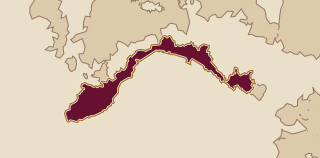
Luni sits at the far northeast corner of Liguria, in a coastal corridor between the Apuan Alps and the Gulf of La Spezia. The Apuan Alps, rising abruptly behind the coast, push cool air down into the vineyards and slow the ripening that Mediterranean sun would otherwise accelerate. Vermentino retains its acidity instead of converting it to weight and alcohol.
The soils are limestone and clay, which drain well and force vine roots to search. That search concentrates the fruit rather than encouraging vigour. Colli di Luni DOC covers this corridor and extends a short distance into Tuscany. The label places Vermentino at the centre of the zone: the DOC framework was designed around the grape, and every tier of the Cantine Lunae range reflects what different parcels and vine ages do with it.
In the cellar
Vineyards and cellar
The estate works three categories of land: owned parcels, leased parcels, and fruit from grower partners. This arrangement gives the winemaking team access to a wider range of parcel types and vine ages than purely owned land would allow. The Etichetta Nera draws from older vines, and the Numero Chiuso is a limited single-vineyard expression produced only in suitable years, which means the grower-partner network underpins the volume of the entry-tier Etichetta Grigia while the prestige tiers are built from more tightly controlled fruit.
For Mea Rosa, the cellar method is central to the wine's character. The rosé blend of Ciliegiolo, Merlot, and Vermentino Nero undergoes cold maceration on the skins for 24 hours, with fermentation at controlled temperatures. The cold maceration extracts colour and a degree of tannin without pulling the bitter phenolics that a longer extraction would give. The temperature control during fermentation preserves the aromatic compounds that make the wine smell of strawberry and hibiscus rather than cooked fruit.
Wines to know
The range in view
The range is organised around three Vermentino expressions and a rosé. The Etichetta Grigia (Grey Label) is the entry-level bottling: aromatic, citrus-forward, and built for early drinking. Its purpose in the range is approachability; the grape shows its floral and stone-fruit aromatics without the weight of older-vine material.
The Etichetta Nera (Black Label) comes from older vines in a single vineyard. It has more body than the Grigia, with stone fruit and a longer finish. The extra vine age concentrates the flavour without sacrificing the acidity associated with Luni Vermentino.