
Why it matters
The producer
Cantine Nicosia was farming Etna's volcanic slopes before the volcano became fashionable. Founded in 1898 in Trecastagni, on the mountain's southern side, the estate has stayed in the same family across five generations. Carmelo Nicosia now leads it alongside his sons Francesco and Graziano.
The range is split across two Sicilian geographies that could not be more unlike each other: 85 hectares of high-altitude volcanic land on Mount Etna in the east, and separate vineyards in the Vittoria zone in the south. One side gives you black basalt soils, cool nights, and a thin-skinned red grape that tastes almost nothing like Sicily. The other gives you warmth, fuller fruit, and a different argument about what the island can produce.
Place and vineyards
Where the wines begin
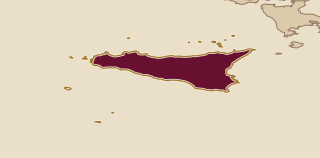
Trecastagni sits on the southern flank of Mount Etna, the active stratovolcano that dominates eastern Sicily. The vineyards here sit at 650 to 750 metres above sea level, high enough that summer nights are cool and harvest arrives later than the rest of the island. The soils are black volcanic basalt and ash, with low organic content and fast drainage.
Those conditions change what a red grape produces. In the vineyards below sea level or on the warmer plains of southern Sicily, Nero d'Avola and Syrah ripen to deep, sun-saturated fruit and dense, dark colour. On Etna at altitude, Nerello Mascalese goes in the other direction: lighter in colour, higher in acidity, mineral on the finish. The appellation is Etna DOC, and both the Vulkà Etna Rosso and the varietal Nerello Mascalese carry that name on the label.
In the cellar
Vineyards and cellar
On Mount Etna, the Nicosia vineyards run from 650 to 750 metres elevation. At that altitude, Nerello Mascalese ripens slowly across a long growing season, building acidity and aromatic complexity before harvest. The grape is thin-skinned, which limits colour extraction and produces wines with a translucent ruby rather than the deep garnet typical of warmer Sicilian reds.
The Vittoria vineyards in southern Sicily operate under different conditions: warmer temperatures, more sun, and soils that push grapes toward fuller, riper fruit profiles. The wines from that zone carry a noticeably different character from the Etna bottles.
Wines to know
The range in view
The range has two anchors: the Etna reds built on Nerello Mascalese, and a white blend that crosses Sicilian native grapes with Viognier.
Vulkà Etna Rosso is the Etna DOC red blend: 80% Nerello Mascalese with 20% Nerello Cappuccio, from the volcanic vineyards at 650 to 750 metres. It is brilliant ruby in the glass, lighter in colour than its southern Sicilian counterparts. The nose is floral and spiced with red berries. On the palate it is juicy, dry, and medium-bodied, with chewy, velvety tannins, tart acidity, and a long fruity finish underlaid with mineral character.
A useful way in
A bottle to begin with
Start with the Vulkà Etna Rosso. It is 80% Nerello Mascalese and 20% Nerello Cappuccio, grown on black volcanic soils at 650 to 750 metres on the southern slopes of Etna. The colour is a clear, brilliant ruby. The nose gives floral lift and red berry fruit before spice and smoke move in. The palate is medium-bodied, juicy, and dry, with chewy tannins, tart acidity, and a finish that moves from fruit through wet stone and eucalyptus. A professional reviewer noted it reminded them more of Pinot Noir than of any Sicilian red they expected, and that comparison captures exactly what altitude and volcanic soil do to this grape.