
Why it matters
The producer
Cantine Paolo Leo farms Salento's two great indigenous red varieties from a family estate in San Donaci, a village at the heart of Puglia's sun-baked heel. The family's connection to the land predates the formal winery: Paolo's father, Nicola Leo, was already making wine at Masseria Monticello at the turn of the twentieth century. Paolo founded the modern cantina in 1989, and in 2000 his generation took a decisive step, buying land outright and building a production facility to move the family from grape traders into growers and bottlers. That shift is what the estate runs on today.
Four of Paolo's sons now divide the enterprise between them. Stefano manages international markets, Nicola works as oenologist, Alessandro handles branding, and Francesco brings economic oversight. The operation is large and deliberately export-oriented: a 24,000 square metre facility with an automated bottling line capable of 6,000 to 7,000 bottles per hour, reaching 36 countries. Equalitas certification covers the sustainability framework. Scale and family ownership coexist here without contradiction.
Place and vineyards
Where the wines begin
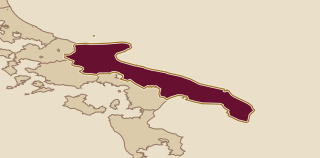
San Donaci sits in the Salento peninsula, the narrow strip of land that forms the tip of Italy's boot, bounded by the Adriatic to the east and the Ionian Sea to the west. The peninsula's climate is extreme by Italian standards: summers are long and fierce, rainfall is low, and the land is almost flat. These are conditions that Primitivo and Negroamaro evolved to handle. Both are thick-skinned, late-ripening varieties that accumulate sugar readily and produce wines of natural depth and body.
San Donaci falls within the Primitivo di Manduria DOC zone, one of Puglia's most important appellations for the variety. Wines labelled under this DOC carry a legal commitment to minimum alcohol levels and geographical origin that distinguishes them from broader regional designations. Salento IGP is the wider category used for blends or varieties that fall outside the DOC rules, and Negramante, the estate's Negroamaro, carries that label.
In the cellar
Vineyards and cellar
Albarello cultivation defines the estate's vine management. The bush-trained system, grown without support wires, controls vigour and forces each vine to self-regulate under the Salento sun. Berry size stays small, skin-to-juice ratios stay high, and the resulting fruit is concentrated and deeply coloured before it reaches the cellar.
For Passitivo Primitivo, concentration goes a step further through the appassimento technique. Before harvest, workers move through the vineyard and apply il giro del picciolo, twisting the stem of each bunch just enough to cut the flow of water from the vine to the fruit. The grape does not go into a drying loft. It desiccates on the vine over several weeks in the late-season heat, shrinking and darkening as sugars and flavour compounds pull inward. By picking time, the bunches are heavier in potential than fresh-harvested fruit would be.
Wines to know
The range in view
The range is anchored by two reds that each reflect a different face of Salento's indigenous varieties.
Passitivo Primitivo is the estate's most distinctive label. Made from partially vine-dried Primitivo grapes and aged in American oak then stainless steel, it is full-bodied and deeply coloured, with plum, cinnamon, and thyme on the nose and a chocolatey raisin depth across the palate. The tannins are generous and the body broad, with a finish that carries the dried-fruit density through without turning heavy. It sits at 14 per cent alcohol.
A useful way in
A bottle to begin with
Passitivo Primitivo is the bottle to begin with. It is Primitivo from San Donaci, partially dried on the vine before harvest, aged six months in American oak and six months in stainless steel. In the glass it delivers what makes the estate and the technique legible: the concentrated plum and raisin of vine-dried fruit, the warm cinnamon and thyme from a hot Salento season, the chocolatey depth that oak ageing adds without obscuring, and a finish long enough to make the method feel real. No other bottle in the range makes the connection between place, grape, old field practice, and modern cellar work as clearly as this one.