
Why it matters
The producer
In 1950, nine grape farmers in the Province of Reggio Emilia did something the post-war wine market was not expecting: they pooled their production instead of competing with it. The cooperative they formed, Cantine Cooperative Riunite, grew into the largest Lambrusco producer in Italy. Eleven years after that founding, four wineries in neighbouring Modena province built CIV along the same lines. The two cooperatives ran separately for nearly five decades and merged in 2008 to form the current entity, Cantine Riunite & CIV.
The scale today is substantial. More than 1,400 vine-growers farm roughly 4,600 hectares across Reggio Emilia and Modena, supplying eight winemaking centres and three production facilities. The flagship commercial brand is Riunite, with Lambrusco distributed to over 100 countries. By the early 1980s, the cooperative had already surpassed one million hectoliters of bottled wine annually and ranked as the third-largest wine group in the world. That peak was built not on classified vineyards or a famous family name but on a collective of small agricultural producers who agreed to work under one label.
Place and vineyards
Where the wines begin
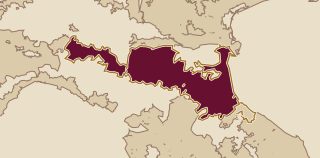
Reggio Emilia and Modena sit on the Po Plain in Emilia-Romagna, one of Italy's great agricultural flatlands. The landscape is alluvial, the winters cold, and the summers warm and humid. Fog settles over the plain in autumn. This is not dramatic wine country in the visual sense, but the flat terrain and continental climate are well matched to Lambrusco: the grape ripens reliably on the plains while retaining the high natural acidity suited to sparkling wine.
The appellation covering the core range is Lambrusco Emilia IGT, a broad provincial designation that allows Lambrusco varieties from across the region to be bottled as sparkling wine. The IGT designation reflects the cooperative's sourcing geography: growers across two provinces, not a single village or hillside estate. Lambrusco Reggiano DOC covers wines specifically tied to Reggio Emilia province and carries a tighter appellation designation.
In the cellar
Vineyards and cellar
The cooperative works with Lambrusco varieties and two supporting grapes across its range. Ancellotta, a deep-coloured variety, is blended into the Amabile and the Secco to add colour intensity and weight on the palate. Lambrusco Maestri, used in the Secco, contributes grip and a dry, slightly tannic finish.
Cellar method varies by wine. The Amabile, Rosé, and Secco all use temperature-controlled fermentation in tank. For the Rosé, soft pressing without skin contact and a chilled-tank prise de mousse preserve the pale pink colour and floral freshness. For the Amabile, winemaking choices favour aroma and fruit over colour extraction: lower temperatures, shorter skin contact, preserving cherry lift and residual sugar balance without heaviness.
Wines to know
The range in view
The main accessible range under the Riunite brand runs across four wines, all sparkling, all built on Lambrusco varieties from the Emilia-Romagna plains.
Lambrusco Emilia Secco (Lambrusco Emilia IGT) is dry red Lambrusco blended with Ancellotta and Lambrusco Maestri. The Ancellotta deepens the colour and fills out the palate; the Maestri adds a dry, slightly tannic character and a firmer finish. Vegetal notes run through the fruit.
A useful way in
A bottle to begin with
SenzaTempo is the bottle to choose first. It is Lambrusco Salamino, bottle-fermented at controlled temperature to 2.5 atmospheres, with yeast sediment retained through the wine's life. Before serving, the bottle is inverted. The sediment redistributes. As the wine is poured, the yeast mixes progressively into the glass, and the bread-crust character grows alongside the cherry and blueberry fruit. The final pour is more complex than the first.