
Why it matters
The producer
Cantine Sgarzi Luigi began in 1933 when Luigi Sgarzi planted his first vines in the Emilian countryside near Castel San Pietro Terme, a small town outside Bologna. The estate he built there still stands. What changed, over ninety years and four generations, is where the family farms: the agricultural and winemaking centre moved south to the Salento peninsula in Puglia, where the estate now manages 140 hectares of vineyards on the flat, sun-baked limestone plain between Brindisi and the Adriatic coast.
Stefano Sgarzi, the fourth generation, leads the operation with his wife Nadia. Their children Luigi Leonardo, Anna, and Francesca work at the winery alongside them. The family also holds 40 certified organic hectares in Abruzzo, near the town of Orsogna, giving the range a second regional dimension.
Place and vineyards
Where the wines begin
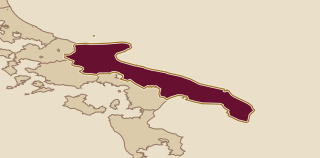
Salento is the southern heel of Puglia, a flat to gently rolling limestone peninsula that extends below the port cities of Brindisi and Taranto into the Ionian and Adriatic seas. The climate is reliably warm and dry, with long growing seasons that push Primitivo, Puglia's dominant red grape, to high natural sugar levels and deep colour. Coastal proximity brings temperature swings between day and night that slow ripening and preserve acidity, which would otherwise be difficult to hold in the heat.
The IGT Salento designation covers the whole peninsula and allows producers to blend across varieties and parcels without the stricter grape composition rules of a named DOC or DOCG appellation. For Sgarzi, the Selezione di Famiglia Primitivo Susumaniello blend is labelled Salento rather than under a more narrowly defined wine law zone. The freedom to combine Primitivo's concentration with Susumaniello's acidity and colour without varietal percentage constraints is built into the IGT framework.
In the cellar
Vineyards and cellar
The 140 Salento hectares are farmed using integrated and sustainable agriculture methods, glyphosate-free throughout. Integrated farming at this scale means combining selective approved treatments with careful canopy management, limiting chemical input without adopting full organic or biodynamic certification for the Puglia holdings. The 40 Abruzzo hectares carry certified organic status, a stricter regime that excludes synthetic inputs entirely and requires a multi-year transition period to achieve.
The 2011 winery was purpose-built for both estate bottling and high-volume canning. Solar panels on the roof supply the majority of the facility's energy. The building design used environmentally friendly materials throughout, a deliberate choice that aligned the physical setup with the farming philosophy. For the Selezione di Famiglia Primitivo Susumaniello, the winery handles selection and bottling at the estate level, separating this tier from the broader canned output.
Wines to know
The range in view
The Selezione di Famiglia Primitivo Susumaniello IGT Salento is the flagship bottled wine, a red blend of two Puglian grapes with complementary profiles. Primitivo brings the weight: deep colour, high natural alcohol, forward dark fruit, plum, and dried fig. Susumaniello brings acidity and colour, helping prevent the wine from becoming flat or heavy at the warm-climate ripeness levels typical of Salento harvests. The 2019 vintage of this wine won Gold at both Mundus Vini 2020 and Berliner Wein Trophy 2020, two independent international competitions judged blind.
Beyond the Selezione di Famiglia, the broader range runs to high volumes in the canned format. The 45-million-can annual output implies a wide set of labels and varieties across Salento and Abruzzo, though the specific cuvees in that wider range are not detailed in currently confirmed information. The Abruzzo organic holdings near Orsogna likely feed white and red varieties suited to that cooler Adriatic climate, but the wines from those parcels are not yet documented with the same specificity as the Salento bottled tier.
A useful way in
A bottle to begin with
Selezione di Famiglia Primitivo Susumaniello IGT Salento is the bottle to start with. It is a single bottled red from the estate's 140 Salento hectares, blending Primitivo and Susumaniello, and it won two international gold medals with its 2019 vintage. The wine is full-bodied, dark-fruited, and warm, with Susumaniello's acidity keeping the concentration from becoming heavy. It tastes like Salento: ripe, generous, and direct, without the overworked quality that high-volume southern Italian reds can carry. This is the wine that shows what the family does when they separate the best Salento fruit from the broader canned range and bottle it under the family name.