
Why it matters
The producer
Cantine Vedova is a family-run sparkling wine house in Valdobbiadene, a steep hill town in the Treviso province of northeastern Italy, at the western edge of the Conegliano Valdobbiadene Prosecco Superiore DOCG. The house has been producing since the 1950s and has grown into one of the largest operations in the appellation, crossing one million bottles annually. Volume and quality ambition sit together here in an unusual way: Vedova makes wine at both ends of the Valdobbiadene hierarchy, from broad-zone Prosecco DOC to the Rive single-hillside designation and all the way up to Cartizze, a 107-hectare microzone within Valdobbiadene that carries its own separate DOCG.
The house builds its range around Glera, the thin-skinned, high-acid grape that the entire Prosecco zone depends on. Every bottle Vedova makes is Glera-based, and the range is designed to show what that grape delivers at three levels of geographical specificity: the broad DOC zone, a named Rive hillside in San Pietro di Barbozza, and the concentrated slopes of Cartizze.
Place and vineyards
Where the wines begin
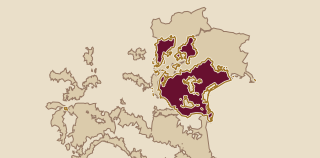
Valdobbiadene sits at the foot of the Dolomites in the Treviso province, where the hills that form the Conegliano Valdobbiadene DOCG rise steeply from the plain. The DOCG, which received UNESCO World Heritage recognition in 2019, covers a narrow band of hillside between the towns of Conegliano to the east and Valdobbiadene to the west. This is the superior tier of Italian Prosecco: grapes grown here carry the Valdobbiadene Prosecco Superiore DOCG label, while wines sourced from the wider northeastern Italian zone use only the Prosecco DOC designation.
The Rive system, introduced into the DOCG regulations in 2009, created a third tier between standard Superiore and Cartizze. A Rive label must name the specific hamlet or hillside where the grapes were grown, with hand-harvesting required and yields capped at 13 tonnes per hectare. Vedova's Rive fruit comes from San Pietro di Barbozza, one of the steeper subzones in the appellation.
In the cellar
Vineyards and cellar
The Rive parcels in San Pietro di Barbozza are picked by hand during harvest. The slope gradient makes mechanisation impractical, so the yield limit and hand-harvesting requirement that the DOCG imposes as a rule function here partly as a practical reality. Limiting fruit to 13 tonnes per hectare keeps concentration in the Glera and preserves the Rive wine's freshness.
All wines across the range are made by the Martinotti-Charmat method. After an initial fermentation in stainless steel tanks, the base wine undergoes a second fermentation in sealed pressurised vessels called autoclaves, where the carbonation develops before the wine is filtered and bottled under pressure. This approach produces Prosecco's characteristic soft, continuous mousse rather than the fine, persistent perlage of traditional-method sparkling wines. This approach is used for the wines in the range.
Wines to know
The range in view
The range moves across three appellations and a residual sugar spectrum that runs from 9 g/L at the drier end to 24 g/L at the plushest.
Prosecco DOC is the entry level, drawing from the broader northeastern Italian zone rather than the Valdobbiadene hillsides. Lighter in body and fruit weight than the DOCG tier, it is intended for early, uncomplicated drinking.
A useful way in
A bottle to begin with
Nebbia Prosecco Superiore Rive Brut is the right starting point. It is a brut-style Glera from the San Pietro di Barbozza hillside in Valdobbiadene, with residual sugar around 9 g/L, made by the Martinotti-Charmat method. The nose gives golden apple, white peach, acacia flower, and a clean, slightly mineral freshness from the hillside fruit. On the palate it is dry and lively, with fine persistent bubbles, a fresh mid-palate, and a clean harmonic finish. At 11% ABV it is light enough to drink without food but carries enough acidity to cut through a plate of cured meats or light shellfish.