
Why it matters
The producer
Cape Point Vineyards is a family-owned wine estate in Noordhoek on South Africa's Western Cape, and its defining wine is cool-climate Sauvignon Blanc shaped by Atlantic breezes and maritime conditions. Sybrand Van Der Spuy and Stephen Newton are the named owners. The current production team includes head winemaker Riandri Visser, winemaker Anzette Visser, viticulturist Steffan Lochner and cellar master Hannes Meyer. The two vineyard addresses divide the range by exposure, giving white and red wines separate starting points.
Wine is also part of the estate's physical setting. Cape Point combines production with a restaurant, a tasting room, open-fire courtyard dining and picnics. The visitor offer keeps the wines alongside the Noordhoek landscape, from Sauvignon Blanc and Chardonnay to the red varieties planted at Scarborough.
Place and vineyards
Where the wines begin
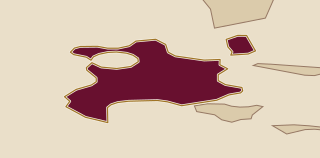
Noordhoek is the home estate, and Scarborough is the second Cape Peninsula property. The peninsula narrows to 11 kilometres at its widest point, and cool sea breezes from the meeting of two oceans slow grape ripening along it. That slower ripening underpins the estate's cool-climate white style, while Scarborough's warmer north-facing slopes were chosen for Cabernet Sauvignon and Shiraz, the red-wine plantings.
At the site level, aspect and air are the dividing line. Noordhoek's cool south-facing slopes carry Sauvignon Blanc, Sémillon and Chardonnay, so three white varieties share a cooler planting position. Scarborough's warmer north-facing slopes carry Cabernet Sauvignon and Shiraz selected for red-wine production. The contrast changes the range before cellar work begins: white grapes come from the cooler exposure, and red grapes from the warmer one.
In the cellar
Vineyards and cellar
At Noordhoek, Sauvignon Blanc, Sémillon and Chardonnay were planted on cool south-facing slopes. At Scarborough, Cabernet Sauvignon and Shiraz were planted on warmer north-facing slopes selected for red wines. The varieties therefore arrive with separate site roles: Sauvignon Blanc and the other white grapes carry the Noordhoek side of the estate, while Cabernet Sauvignon and Shiraz carry Scarborough's red-wine side.
Viticulture and cellar work are named as distinct jobs in the current team. Steffan Lochner is the viticulturist, Hannes Meyer the cellar master, with Riandri Visser as head winemaker and Anzette Visser as winemaker. For the house's cool-climate Sauvignon Blanc, Atlantic breezes and maritime conditions shape the style. Cool air slows ripening before the grapes reach the cellar, linking the coastal site to the wine's cool-climate character.
Wines to know
The range in view
The range reads first as a white and red split. Noordhoek supplies Sauvignon Blanc, Sémillon and Chardonnay, with cool-climate Sauvignon Blanc at the centre. Scarborough supplies Cabernet Sauvignon and Shiraz for red-wine production on warmer north-facing slopes. The estate also names red blends and rarer varieties such as Sauvignon Gris, so the catalogue extends beyond the principal five plantings without a blend recipe attached to any one bottle.
One bottle has an especially clear role in that range. Cape Point Vineyards Chardonnay 2024 is 100% Chardonnay, a single-variety white with full body, lively acidity and a long, persistent finish. Those cues lend it weight, freshness and length, while the estate's Sauvignon Blanc keeps the range tied to its Atlantic, maritime setting.
A useful way in
A bottle to begin with
Start with Cape Point Vineyards Chardonnay 2024. It is 100% Chardonnay, so the grape is explicit on the label, and the wine is full-bodied with lively acidity and a persistent finish. Together, these features put palate weight and freshness in the same glass. It is the right first bottle because the white side of the estate becomes tangible in one bottle, from a named grape to a long finish.