
Why it matters
The producer
Capo di Vigna farms 100 hectares of flat calcareous-clayey land at the far eastern edge of Veneto, in the locality of Villanova di Motta di Livenza, where the plain runs close to the Friuli Venezia Giulia border. The Lunardelli family has worked these vineyards across three generations, moving from grape cultivation to estate production to a fully integrated sparkling wine operation built around Prosecco.
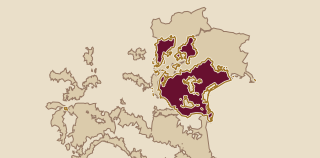
The estate sits within four denominations: DOC Piave, DOC Venezia, DOC delle Venezie, and DOC Prosecco. Its premium tier reaches into the Asolo Prosecco Superiore DOCG, a separate appellation in the Treviso hills that carries the highest official standing in the Prosecco hierarchy. That range of appellations gives Capo di Vigna a broad production canvas, from everyday Glera-based frizzante to a DOCG bottling held back for weeks of bottle rest before release.
Place and vineyards
Where the wines begin
Motta di Livenza sits near the northeastern corner of Veneto, where the flat alluvial plain stretches toward the Friuli Venezia Giulia border. The soils here are calcareous and clayey, with a microclimate that supports even grape ripening across the growing season. Flatland viticulture in this part of Veneto produces wines with a softer natural acidity than hillside Prosecco from further west, and the Glera grape responds to the calcareous fraction in the soil with the floral and apple-fruit character typical of the denomination.
The DOC Prosecco appellation covers a large zone across Treviso and Friuli. Within it, Asolo Prosecco Superiore DOCG is a smaller, hill-based sub-zone in the Treviso province with a separate and superior classification. The hilly terrain of Asolo concentrates ripeness and aromatic depth differently from the flat land around Motta di Livenza, which is why the estate's Asolo bottling occupies a distinct tier above the DOC range.
In the cellar
Vineyards and cellar
The 100 hectares spread across Motta di Livenza, Cessalto, and Gorgo al Monticano are managed under sustainable viticulture principles, with continuous vineyard renewal. Glera is the dominant variety, as required by Prosecco DOC and DOCG regulations, which mandate a minimum of 85 percent Glera in any Prosecco blend.
In the cellar, the Prosecco DOC Frizzante undergoes secondary fermentation in autoclave over approximately 20 days, which generates the light, fine bead characteristic of the frizzante style. The Prosecco DOC Brut is fermented at approximately 18 degrees Celsius, with fermentation running until sugars are fully consumed, producing a drier, more fully sparkling wine. The Asolo Prosecco Superiore DOCG receives additional bottle rest before release, allowing the floral and citrus aromatics to fully open and integrate.
Wines to know
The range in view
The Capo di Vigna range is built around Prosecco at three levels of appellation and style.
The Prosecco DOC Frizzante is lightly sparkling, straw yellow with green reflections and a fine, persistent bead. White flowers and Golden Delicious apple dominate the nose. The palate is soft, low-pressure, and approachable, with the mousse sitting as a gentle texture rather than a full sparkle. This is a lunch-table wine: easy to pour, low in alcohol relative to the still wines in the range, and designed to be drunk young.
A useful way in
A bottle to begin with
Start with the Asolo Prosecco Superiore DOCG. It is Glera from the Asolo hills appellation, held for several weeks of bottle rest before release, which means the floral and citrus bouquet has had time to develop and integrate before the wine reaches a glass. The bead is fine and persistent, the mousse is light, and the finish carries a clean citrus lift without heaviness. The DOCG classification places it at the top of the Prosecco hierarchy, and the Asolo sub-zone is a well-defined territory with a character that is distinct from the flat-land DOC wines in the same range. It shows what the estate is working toward, and it shows it clearly.