
Why it matters
The producer
In July 2018, Borgogno, the historic Barolo house owned by the Farinetti family, and Francesco Tornatore, whose Cantina Tornatore had farmed the north slope of Etna for years, jointly signed for Villa dei Baroni in Contrada Carranco. The deal covered twenty hectares of vineyards and olive groves on the volcanic north side of Castiglione di Sicilia. The estate already had everything they needed: fifty-to-sixty-year-old vines, an eighteenth-century palmento with its original basalt-lined tanks still in use, and some of the most valued land on the volcano's northern arc.
They named the project Carranco, after the contrada itself. Six wines now come from eight hectares, totalling around 35,000 bottles a year. The collaboration brought together two very different bodies of knowledge: Borgogno's long experience with calibrated oak ageing and extended maceration in Piedmont, and Tornatore's native fluency with Etna's soils, vine stock, and seasonal rhythms. Both partners grow only native Sicilian varieties. No international grapes are planted.
Place and vineyards
Where the wines begin
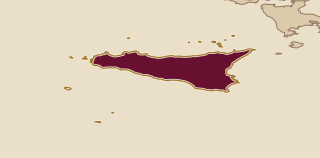
Etna is a live volcano in northeastern Sicily, and its north slope, centred on the township of Castiglione di Sicilia, is where most of the island's wine-serious attention has landed over the past two decades. The volcano's altitude and aspect moderate what would otherwise be punishing Sicilian heat: at 500 metres in Contrada Carranco, temperatures are cooler than the valley floor, and the season runs long enough to preserve acidity in both red and white grapes.
The dominant material underfoot in Contrada Carranco is basalt, the dark volcanic rock that Etna produces in abundance. Vine roots on basalt terraces reach into fractured rock rather than deep soil, limiting vigour and concentrating the crop. The cru parcel at the estate's northern edge sits among exposed basalt outcrops and is planted entirely to bush-trained vines on those narrow terraces, a configuration that dates to when the vineyard was first established fifty to sixty years ago.
In the cellar
Vineyards and cellar
The eight hectares are farmed sustainably across two main parcels. Most of the vineyard is Nerello Mascalese, with Nerello Cappuccio added as a blending component and Carricante grown in the northernmost sector for the white wines. A portion of the estate retains traditional bush-vine training, alberello in Italian, which keeps the canopy low and forces each plant to support a smaller crop load. The Contrada Carranco cru uses only bush-trained vines.
The eighteenth-century palmento at Villa dei Baroni is still in active use, its original basalt-lined tanks incorporated into the working cellar alongside concrete and wood.
Wines to know
The range in view
The range divides into two tiers across two colours.
The Villa dei Baroni tier is the estate entry level. Etna Bianco Villa dei Baroni is a Carricante-based white vinified in stainless steel and aged in wood, with the producer describing it as structured and built for moderate ageing. Etna Rosso Villa dei Baroni blends Nerello Mascalese with Nerello Cappuccio, fermented in concrete and aged in oak: the Cappuccio component deepens the colour and softens some of the Mascalese's angular tannin, while the volcanic mineral character persists across both.
A useful way in
A bottle to begin with
Start with Etna Rosso Villa dei Baroni. It is Nerello Mascalese with Nerello Cappuccio, fermented in concrete and aged in oak, and it puts both grapes and both partners' thinking into a single accessible bottle. The Cappuccio gives the colour some depth without masking the Mascalese's pale transparency; the concrete fermentation preserves a freshness that oak-forward ageing would dull. What you get is firm tannin, red fruit, and a savoury volcanic mineral presence that explains why this part of Sicily attracts serious wine attention. It is the most direct route into what Carranco is doing before committing to the single-parcel Contrada tier.