
Why it matters
The producer
In a corner of southeastern Spain where the sun and the plateau conspire to produce some of the darkest, most extracted red wines in the country, Casa Castillo has been making the opposite argument for thirty years. The estate sits in the Jumilla appellation in Murcia, on the northern slopes of the Sierra de El Molar at 700 metres, farming Monastrell, Garnacha and Syrah as dry-land bush vines. The wines are structured but not heavy, and the fruit reads as place rather than force.
Four grandchildren of the original owner now run the property: Guillermina, Julia, Marisol and José Maria Vicente Sánchez-Cerezo. The estate covers 420 hectares in total, of which 170 are vineyards. Every grape in the bottle is estate-grown. The Jumilla appellation lists the producer as ecological.
Place and vineyards
Where the wines begin
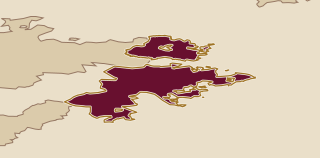
Jumilla straddles the border of Murcia and Castilla-La Mancha in the arid southeast of Spain. It is landlocked and extremely dry, sitting on plateau terrain at altitude. The appellation has long produced powerful, sun-driven reds from Monastrell, a variety that thrives under stress and low rainfall. In this climate, concentration is not a winemaking achievement. It arrives automatically.
Casa Castillo's vineyards occupy the northern slopes of the Sierra de El Molar at 700 metres. That altitude matters. Warm days are followed by cool nights that preserve acidity and slow the accumulation of sugar. The northern aspect adds further moderation, keeping the fruit on the vine long enough to ripen without cooking. The result on the label is Jumilla red wine that can be served at a dinner table rather than poured over a steak.
In the cellar
Vineyards and cellar
All three varieties, Monastrell, Garnacha and Syrah, grow as bush vines on dry land. The vines receive no irrigation and produce low yields. Harvesting is done by hand. Grapes go through a double sort, once in the vineyard and once in the winery, then are chilled to 14 degrees Celsius before processing begins. That cold step slows oxidation and preserves the aromatic character of the fruit before fermentation.
Wines to know
The range in view
The range is built around three named wines, each with a different grape emphasis and a different position in the range.
El Molar is 100 percent Garnacha, the 2018 vintage confirmed at that composition. The wine is lighter-bodied than Monastrell typically produces in Jumilla, with red fruit, dried herb and spice from old-vine Garnacha on the plateau. The 2018 has bright raspberry and cherry fruit, light tannins and spice.
A useful way in
A bottle to begin with
Start with Pie Franco. It is 100 percent Monastrell from the ungrafted massal-selected plot, vinified with whole bunches at 40 to 60 percent, fermented with native yeasts, and aged in oak foudre. The wine is dark-fruited and structured, with depth from the ungrafted vines and a savoury lift from the whole-bunch element that keeps it from reading as a warm-climate bruiser. It is the bottle that shows most directly what the estate is doing and why the decisions in the cellar matter: the fruit is Jumilla, but the weight and the texture are the result of deliberate choices made against the regional grain. The 2023 vintage is available through Liberty Wines in the UK.