
Why it matters
The producer
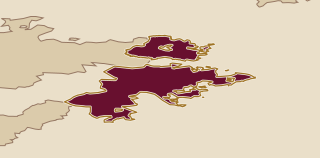
Casa Los Frailes grows Monastrell on calcareous limestone at 650 metres in the Alforins hills, a fold of inland Valencia about 80 kilometres from the coast. The estate covers 162 hectares: 130 are vineyards, the rest Mediterranean forest, almond trees, and olive groves. Every wine is fermented, aged, and bottled on the property.
The vines are old. Across the 130 hectares the average vine age is 40 years; a portion of the Monastrell parcels carry bush vines older than 75 years. Yields run around 2,500 kilograms per hectare from unirrigated ground. The Velázquez family has owned the estate since 1771 and now farms it in its thirteenth generation.
Place and vineyards
Where the wines begin
The Alforins valley sits in the southwestern interior of Valencia province, a dry inland basin where elevation lifts the estate well above coastal orchard country. At 650 to 700 metres, nights cool sharply even in summer, which slows Monastrell to a longer hang time, holds natural acidity, and allows the grape to reach full colour and concentration without the cooked, pruney character that afflicts lower-altitude Valencian reds.
The appellation is DO Valencia, which covers a large and variable territory. The Alforins sub-zone carries some of the coolest and highest vineyard land in the region. The limestone soils drain freely and limit water retention, which stresses the vine into lower yields and more concentrated fruit without requiring irrigation. The label reads DO Valencia, but the character in the glass traces to that elevation and to the limestone.
In the cellar
Vineyards and cellar
The 130 hectares of Monastrell are farmed as bush vines without irrigation. In winter, a flock of about 1,000 sheep grazes between the rows; their manure is composted and returned to the soil. Winter cover crops of legumes, grasses, and brassicas are planted for drainage, erosion control, and biodiversity. Bees and chickens complete the vineyard ecosystem.
In the cellar, Monastrell is fermented and aged in historic concrete tanks ranging from 110 to 260 hectolitres. The estate retained these vessels deliberately: their porosity allows slow micro-oxygenation during ageing, which matters for Monastrell, a variety prone to reductive character when sealed too tightly. The top-tier Dolomitas is then transferred to buried clay amphoras. The amphoras contribute no wood-derived aromas and allow the grape and site to come through without a oak overlay. Cellar additions are kept to a minimum: some bâtonnage, small sulphite additions before bottling, and light filtration.
Wines to know
The range in view
The estate produces Monastrell-based reds within DO Valencia at several range levels. The grape is consistent across the range: old-vine, bush-trained, dry-farmed, unirrigated Monastrell from calcareous limestone at altitude. What changes between levels is the selection of parcels and the élevage.
Entry-level bottles carry the dark-fruited, earth-inflected character of the variety at this altitude, softened by the micro-oxygenation of concrete ageing. Tannins are moderate rather than gripping, and the limestone gives a clean, dry finish without sweetness.
A useful way in
A bottle to begin with
Dolomitas is the bottle to start with. It is a single-estate Monastrell, fermented in old concrete and then moved to buried clay amphoras for ageing. No oak touches it at any stage. What arrives in the glass is dark-fruited, concentrated Monastrell at altitude: blackberry, dried plum, a mineral thread from the limestone, and acidity that keeps the finish clean and long. The tannins are dry and firm without heaviness, shaped by old bush vines and low yields rather than extraction. If you want to understand what Monastrell tastes like when farmed seriously at elevation and aged without wood, Dolomitas is where that argument is made most directly.