
Why it matters
The producer
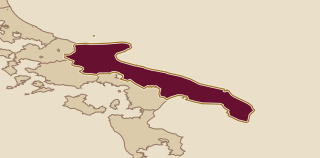
Casa Marzoni makes appassimento wines from Puglia, the long heel of southern Italy that runs into the Adriatic and Ionian seas. The wines are produced in close cooperation with Casa Botter, a Veneto négociant founded by Carlo and Maria Botter in 1928 and now in its third generation. Puglian indigenous varieties are dried on the vine before fermentation, bottled under EU organic certification and sealed by hand with traditional Italian string.
That last detail, the hand-tied spago cord, is the one detail every person who has handled these bottles can describe afterward. In a category where closures are overwhelmingly machine-applied, the gesture is deliberate.
Place and vineyards
Where the wines begin
Puglia runs nearly five hundred kilometres down Italy's south-eastern coast, one of the driest and sunniest agricultural zones in the country. Rainfall is low. Summer heat is sustained and direct. The combination creates exactly the conditions appassimento grapes need during their late-summer drying window: no rot pressure, steady dehydration, fruit that concentrates without spoiling.
The soils are calcareous, pale-toned, and water-retentive. In a region where drought stress is the more common risk, soils that hold moisture matter. The vines draw on that reserve through the dry months and produce grapes with thick skins and high sugar levels before any drying begins.
In the cellar
Vineyards and cellar
When summer turns to early autumn in Puglia, the grapes are left on the vine to dry for approximately two weeks. This is on-vine appassimento, a variation from the more commonly seen indoor drying on straw mats or racks. The vine itself holds the fruit through the drying window. Constant sunshine and soft, steady breezes keep the bunches healthy as moisture evaporates. Grapes can shed up to half their weight during this period.
Before fermentation begins, the dried grapes weigh less and are more concentrated: sugars compressed, acidity concentrated, aromatic compounds packed into a reduced liquid. After two weeks, the dried grapes are hand-gathered in small baskets so they arrive at the winery whole and undamaged.
Wines to know
The range in view
Three wines carry the appassimento label.
Casa Marzoni Appassimento is the signature red. Analytical data from the 2020 vintage puts alcohol at 14.5%, residual sugar at 10 grams per litre, and pH at 3.45. The profile is full-bodied, concentrated, and smooth-textured, with the weight and warmth that comes from fruit dried to near-raisin density before pressing. The blend draws on Montepulciano, Negroamaro, and Uva di Troia with other Puglian and Italian varieties; current vintage proportions are not disclosed. Oak is applied.
A useful way in
A bottle to begin with
Casa Marzoni Appassimento is the red to start with. It is made from Montepulciano, Negroamaro, and Uva di Troia, dried for two weeks on the vine in Puglia, then fermented and aged with oak. At 14.5% alcohol and 10 grams of residual sugar, it is unmistakably a southern Italian appassimento wine: full-bodied, dark-fruited, smooth in texture, and warm through the finish. The spago cord is already tied around the neck when it arrives. Open it with a rich meat dish or ripe cheese. This is what on-vine drying in Puglia produces.