
Why it matters
The producer
Casa Vinicola D'Angelo sits in Rionero in Vulture, a town on the eastern slopes of Mount Vulture, an extinct volcano in Basilicata at the toe of the Italian peninsula. The family showed wines at a Bari trade fair in 1924 and converted entirely to estate bottling under the D'Angelo name by 1950. Four generations later, Rocco D'Angelo runs the winemaking and the vineyards while Erminia and their mother Franca manage sales.
The house is built around one grape and one appellation. Aglianico del Vulture, a thick-skinned indigenous red variety, grows on volcanic soils at altitude and produces wine dense with tannin and dark fruit. Everything D'Angelo does in vineyard and cellar is calibrated to that grape and its capacity to age.
Place and vineyards
Where the wines begin
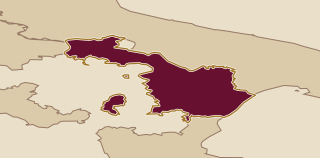
Mount Vulture is volcanic terrain. The soils carry pumice, tuff, and mineral ash laid down over millennia, and they drain freely while holding just enough moisture for the late-ripening Aglianico grape. Rionero in Vulture sits within the Aglianico del Vulture DOC, a zone defined by elevation, volcanic substrate, and the local climate of Basilicata: hot summers tempered by altitude, with cool nights that slow ripening and preserve the natural acidity Aglianico needs to balance its tannin load.
The DOC label tells a buyer that the wine comes from this specific volcanic zone, from Aglianico, and carries the legal minimum requirements for production and ageing. D'Angelo's two vineyard sites, Barile and Maschito, both sit between 400 and 500 metres, where the diurnal temperature shift is sharpest and the fruit develops colour and concentration without losing the acidity needed to balance its tannin load.
In the cellar
Vineyards and cellar
Farming across both sites is sustainable: no certified label is attached, but the approach avoids unnecessary intervention in the vineyard. In the cellar, Rocco relies on native yeasts to drive fermentation, which means a longer, less predictable ferment but one that draws on the ambient microbial character of the place rather than a commercial yeast culture.
For the Aglianico del Vulture, skin maceration runs for ten days. Aglianico is a tannic grape by nature; ten days of contact extracts colour, tannin, and phenolic depth without over-extracting the bitterness that can come from pushing maceration too far on a thick-skinned variety. The wine then matures for 18 months in large barrels. Large-format neutral oak does not add wood flavour; it allows slow oxidative development and gentle integration of tannin without masking the fruit or the volcanic mineral character the grape picks up from the soil.
Wines to know
The range in view
Aglianico del Vulture DOC is the house wine in the fullest sense: 100 percent Aglianico del Vulture, macerated, aged in large neutral oak, and built to develop over years in bottle. The colour is intense ruby with garnet at the rim in a mature vintage, and the tannins are lively rather than polished. The wine spends its first years with firm edges and dark woodland-fruit concentration, then gradually opens into something rounder and more harmonious as the tannin integrates.
D'Angelo also makes wines from Merlot, Primitivo, Malvasia, and Moscato. These sit outside the Aglianico del Vulture DOC and are secondary to the house direction. The Malvasia and Moscato are white and sweet respectively, offering a contrast to the tannic reds. None of these wines carries the same ageing proposition as the flagship.
A useful way in
A bottle to begin with
D'Angelo Aglianico del Vulture DOC is the bottle to start with. It is a single-varietal red from 100 percent Aglianico del Vulture, ten days on the skins, 18 months in large neutral oak, and a further period of bottle refinement before release. In the glass it gives dark fruit, firm tannin, and the kind of acidity that suggests the wine is not done yet. Buy it two to three years after the vintage and it shows clearly what volcanic Basilicata Aglianico is: structured, minerally, dark-fruited, and built to last. Drink it at eight to ten years and the same qualities are present but integrated.