
Why it matters
The producer
Casa Vinicola Luigi Cecchi began as a merchant enterprise. Luigi Cecchi, described by his own family as a wine enthusiast and expert taster, laid the company's foundations in 1893. For decades the business stayed in trade: buying, blending, selling. Then the third generation changed what it was.
In the early 1960s, a second Luigi took the family into the land. He purchased Villa Cerna in Castellina in Chianti, at the heart of the Chianti Classico appellation, and built a winery amid 80 hectares of vineyards. A merchant house had become an estate. That decision gave the company its character, and Chianti Classico has been its home appellation ever since.
Place and vineyards
Where the wines begin
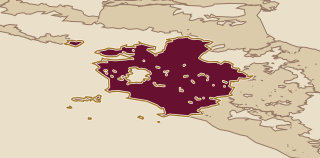
Castellina in Chianti sits near the western edge of the Chianti Classico zone, the legally defined sub-region within Chianti that runs between Florence and Siena in central Tuscany. Chianti Classico is Sangiovese country: the appellation requires Sangiovese as the dominant grape and places strict limits on non-native varieties in its top-tier wines. Castellina lies at elevation, with vineyards spread across the hills above the Elsa and Arbia valleys. The altitude moderates summer heat and preserves the acidity that keeps Chianti Classico alive in the glass.
The Cecchi portfolio extends well beyond Castellina. Maremma, along Tuscany's southern coast, came in 1996 with 25 hectares. Montalcino, home of Brunello, arrived with the 2018 acquisition of six hectares at Aminta in Castelnuovo dell'Abate. Across the regional border in Umbria, Tenuta Alzatura in Montefalco farms native varieties under organic certification. Each address adds a distinct appellation and climate to the family range.
In the cellar
Vineyards and cellar
Across the five estates, the family names vineyard care and clone selection as its primary priorities. Clone work in Sangiovese matters: different selections produce fruit with meaningfully different acidity levels, tannin grain, and colour depth, and the Chianti Classico zone has access to a wide range of locally adapted material. Good clone selection is slow work, and its payoff shows up in the consistency and character of the wine over time.
The Riserva di Famiglia is the window into Cecchi's cellar practice. The 2022 vintage is 90% Sangiovese and 10% Cabernet Sauvignon, aged 12 months in barriques and tonneaux before at least three months in bottle. Barriques (225-litre barrels) give more wood contact per litre and add tannin and oxygen; tonneaux (500-litre barrels) moderate that contact and allow slower, gentler development. The combination is a common approach in Chianti Classico Riserva production: enough oak to age and integrate the wine, not enough to cover the Sangiovese fruit.
Wines to know
The range in view
The Cecchi range is organised by estate and appellation. At its centre is the Chianti Classico line from Villa Cerna and Villa Rosa, with the Riserva di Famiglia as the confirmed flagship. That wine is 90% Sangiovese, 10% Cabernet Sauvignon, matured in barriques and tonneaux. It sits at the Riserva tier within Chianti Classico, which requires extended ageing beyond the standard annata wines and tends to show more weight and complexity in the glass. The small Cabernet component adds body and colour to the Sangiovese base without pulling the wine toward an international style.
Beyond Chianti Classico, Cecchi holds appellations across two regions. Maremma delivers a different climate: warmer, coastal, with fuller-bodied red wines and riper fruit than the Chianti hills. Aminta in Montalcino grows in the shadow of Brunello, one of Italy's most demanding red wine appellations. Tenuta Alzatura in Montefalco produces native Umbrian varieties organically, a range separate in character and grape from the Tuscan operation.
A useful way in
A bottle to begin with
Start with the Chianti Classico Riserva di Famiglia. It is 90% Sangiovese from the Castellina in Chianti vineyards, blended with 10% Cabernet Sauvignon, aged 12 months in barriques and tonneaux and then rested in bottle before release. In the glass it is dry, firm and savoury: dark cherry and earth on the nose, structured tannin in the mouth, a long finish of herb and dried fruit. It sits at the Riserva level in Chianti Classico, which means it carries more weight and depth than the entry annata wines and is built to age. Drink it now with food, particularly red meat and aged cheese, or hold it for five years and find something more rounded.