
Why it matters
The producer
Cascina Cappelle makes wine on a limestone hill at the edge of Mongardino, a small commune in the Asti province of Piedmont. The estate sits directly at the Sanctuary of Saint Anthony of Padua, a working pilgrimage site whose stone chapels give the farm its name: cascina means farmstead, cappelle means chapels. Six generations of the same family have worked this ground continuously since 1890.
The range is a map of the appellations surrounding Asti: Barbera d'Asti in two Superiore expressions, Monferrato Nebbiolo, Monferrato Dolcetto, and Grignolino d'Asti. Barbera is the lead grape, and the two Superiore wines are where the estate's clearest cellar choices show.
Place and vineyards
Where the wines begin
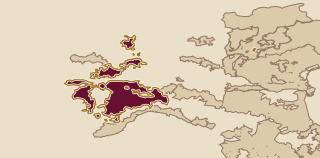
Mongardino sits in the Monferrato hills of southern Piedmont, south-east of the city of Asti. The surrounding appellations are mid-tier by Piedmont standards: Barbera d'Asti DOCG covers the grape-forward reds that have long anchored everyday Piedmontese tables, while Monferrato DOC is a broader zone that allows Nebbiolo and Dolcetto to carry the regional label without the prestige weight of Barolo or Barbaresco to the south-west.
The Monferrato Nebbiolo DOC is a different proposition: grown on the same fossil-bearing limestone soils as the estate's Barbera, but outside the communes that define the southern Langhe hierarchy. The label reads Monferrato, not Barolo, and the style reflects that: rounder and more accessible, without the decade-long ageing demand of the prestige appellations.
In the cellar
Vineyards and cellar
Grapes are hand-picked and moved to the cellar at what the estate judges to be optimal ripeness, a practice that prioritises selection over calendar scheduling. Rootstock selection is adapted to the limestone soils.
In the cellar, the two Barbera Superiore wines diverge at the barrel. The Riserva goes into medium-toasted French oak barriques for at least 24 months. The barriques add palate softness and extend the wine's life. The non-Riserva Superiore uses indigenous Piedmontese barrels, typically larger-format botti that give slower, more neutral oak contact over the same minimum 24-month period. Larger oak means less wood flavour transferred per litre, so the fruit and grape character of the Barbera remains more exposed.
Wines to know
The range in view
The range covers four appellations and five wines, anchored by Barbera.
Barbera d'Asti Superiore Riserva is the flagship: Barbera from limestone parcels, aged for a minimum 24 months in medium-toasted French oak barriques. The barrique contact rounds the palate and adds a spiced, oak-derived layer over Barbera's firm cherry fruit. Extended ageing under Superiore Riserva rules means this bottle arrives with more development than the base release.
A useful way in
A bottle to begin with
Start with the Barbera d'Asti Superiore from the 50-year-old vineyard, aged in Piedmontese botti. It is the most direct expression of what the estate grows and where: old-vine Barbera on limestone, cellared in traditional large-format oak for over two years, with the grape's natural red fruit and acidity intact. The botti leave the wine more transparent to its vineyard than the barrique does, which makes it a clearer first read of the estate's ground.