
Why it matters
The producer
Cascina Chicco takes its name from "Chicus," the local Roero nickname of the Faccenda family. Ernesto Faccenda, a butcher by trade, bought one hectare of vineyard in Canale in 1950 and began growing Nebbiolo and Barbera for local sale. His son Federico and Federico's wife Maddalena converted that farming operation into an estate, bottling wine under the family name. In the 1980s, Federico and Maddalena's sons Enrico and Marco trained at the Oenological School in Alba and brought the estate to its current scale.
Today the estate spans more than 50 hectares across Canale, Vezza d'Alba, Castellinaldo d'Alba, Barbaresco and Monforte d'Alba. The guiding principle is uncomplicated: plant and vinify each grape variety in the commune where it performs best. Arneis goes into sandy Roero soils in Canale. Barbera is grown in Castellinaldo. Nebbiolo appears across three levels, from a cross-commune Langhe blend to named-site Roero, Barolo from Monforte MGAs, and Barbaresco from the Ovello cru.
Place and vineyards
Where the wines begin
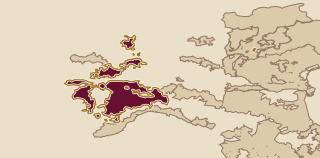
Canale sits on the right bank of the Tanaro river, in the Roero, the smaller and less-known half of a wine landscape that most buyers know primarily from the left bank. Across the Tanaro lies the Langhe, where Barolo and Barbaresco are made on clay-rich, limestone-veined soils. The Roero is different in almost every physical respect: soils are sandy, the terrain is more deeply eroded, and the growing conditions favour aromatic whites and lighter Nebbiolo rather than the extracted, tannin-heavy reds of the Langa.
Roero Arneis is the DOC built entirely around this sandy-soil character. The Arneis grape, indigenous to the Roero, produces a white wine that is aromatic and stone-fruited, with relatively low acidity compared to the high-acid reds grown across the river. Nebbiolo farmed on Roero soils, particularly at the Valmaggiore parcel, gives a lighter, more floral expression than Barolo.
In the cellar
Vineyards and cellar
The estate's approach is to match grape to commune rather than blend across the full holding. Arneis is farmed at Canale, where sandy soils and early warmth give the grape its characteristic stone-fruit and floral aromatics without excess weight. Barbera is planted at Castellinaldo d'Alba, where the grape's naturally high acidity is channelled into wines with deep colour and lively palate freshness.
Nebbiolo is handled differently at each address. The Valmaggiore parcel in the Roero produces a lighter, more floral Nebbiolo. The Monforte MGAs on the Langa side produce the Barolo, aged in the underground cellar's dedicated barrique and ageing areas. The Ovello cru material in Barbaresco benefits from the hand-dug crutins, where constant temperature and humidity support long, even ageing.
Wines to know
The range in view
The range opens with Roero Arneis, a DOC white from Arneis grapes grown in Canale's sandy Roero soils. Arneis here is aromatic and stone-fruited, with modest acidity and a soft, rounded texture.
Barbera d'Alba comes from Castellinaldo, where the grape's deep colour and firm acidity are the defining characteristics. Entry-level Barbera from this address is vinified with less oak contact; reserve expressions spend longer in barrel, adding weight to the high-acid fruit.
A useful way in
A bottle to begin with
Start with the Langhe Nebbiolo DOC. It is a cross-commune Nebbiolo blend, not a single-vineyard wine, and that is precisely what makes it the right first bottle from this estate: it reflects the producer's territorial thinking across several parcels rather than one address. The wine gives Nebbiolo's signature aromatic register, violet, morello cherry, white pepper and spice, without the extended ageing requirement of the Barolo or Barbaresco. The tannin is firm and identifiable but not a barrier. At this level the wine is approachable in its first few years, yet it carries enough depth to hold for five or more. It costs less than the DOCG wines and requires less patience.