
Why it matters
The producer
Castellani S.p.A. has been a Tuscan family wine company since 1903, headquartered in Pontedera and still run by the Castellani family. Five principal estates spread across Tuscany supply the raw material for a range that runs from a clean, stainless-steel Chianti DOCG to a Brunello di Montalcino aged in oak for two years before bottling. A company of this age and reach is a commercial operation, not a small domaine.
Piergiorgio Castellani manages the company today. Sabino Russo works as oenologist. The international distribution touches 42 countries, a figure that reflects the scale of the operation.
Place and vineyards
Where the wines begin
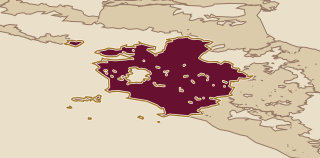
Tuscany is a large region, and Castellani works across several of its most important appellations. The Chianti DOCG, the broadest Sangiovese-based classification in Tuscany, covers a wide band of central territory. The Chianti Classico DOCG, a legally distinct and more tightly bounded zone between Florence and Siena, sits at higher elevation and produces wines with firmer acidity and more concentrated earth character. Brunello di Montalcino DOCG is further south, around the hill town of Montalcino, where Sangiovese Grosso, the local clone of Sangiovese, produces the most tannic and age-worthy red wine in the family range.
Ceppaiano, one of the five estates, has vineyards with mainly sandy soils. Poggio al Casone is farmed organically. Each estate contributes to a range that maps broadly across Tuscan Sangiovese, from accessible to structured.
In the cellar
Vineyards and cellar
At Poggio al Casone, organic farming means the vineyard receives no synthetic treatments. Vinification follows organic methods through the cellar as well: the commitment runs from vine to bottle, not to a farming certificate.
At Ceppaiano, estate-grown grapes from mainly sandy soils go through the Governo all'Uso Toscano process. After the primary alcoholic fermentation is complete, a portion of must is added to the wine to trigger a second fermentation. The added must reactivates activity in the finished wine, builds additional body, and gives the resulting red a softer, rounder texture than a single-fermentation Sangiovese of the same fruit weight.
Wines to know
The range in view
The Famiglia Castellani Chianti DOCG is Sangiovese-led, vinified in stainless steel, with violet and cherry on the nose and a dry, savory palate that softens through the mid-palate. Tannins are present but light, and the finish is clean. It is the most approachable wine in the range and the one most suited to a simple meal.
The Famiglia Castellani Chianti Classico DOCG Riserva moves into different territory. The Chianti Classico zone adds altitude and different soil compared to the broader Chianti DOCG, and the 24-month minimum maturation brings earthier aromas, leather, firmer acidity, and a longer finish than the basic Chianti. It carries more weight on the palate and holds that weight through a longer finish.
A useful way in
A bottle to begin with
Start with the Famiglia Castellani Chianti DOCG. It is Sangiovese in its most direct Tuscan form: no oak, no extended maturation, just controlled fermentation in stainless steel and the grape's own violet-and-cherry character on a dry, savory palate. The tannins soften through the mid-palate and the finish is clean. It is made entirely in stainless steel, with violet and cherry aromas and a dry, savory palate. One bottle of this and the Riserva makes a useful pair: you will hear exactly what 24 months of maturation adds.