
Why it matters
The producer
Castello della Paneretta sits on the western edge of the Chianti Classico zone, on slopes above the Val d'Elsa with views toward the towers of San Gimignano. The estate grows nothing but Sangiovese and Canaiolo Nero across eight named parcels. No Merlot, no Cabernet, no international concessions.
The Albisetti family took ownership in 1984 and has maintained that narrowness as a position. Of the 309 hectares they farm, 23 are planted to vines. The rest is woodland. Production runs to around 900 hectoliters a year, which is modest for an estate of that physical scale, and the range is built around a Chianti Classico Riserva blended 90 percent Sangiovese and 10 percent Canaiolo Nero, aged in French oak.
Place and vineyards
Where the wines begin
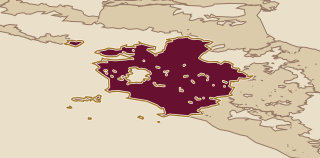
Chianti Classico is the DOCG zone between Florence and Siena. Most of the zone's estates cluster in the Gaiole, Panzano, and Greve corridor to the east. Paneretta lies on the western margin, where the land slopes toward the Val d'Elsa valley rather than eastward toward the Arno tributaries. San Gimignano is visible on the horizon, marking the edge of a different appellation entirely.
This western position changes the morning exposure. Slopes here face east and southeast, catching early sun before afternoon heat builds. The Pliocene soils, shaped when Tuscany had a subtropical climate, include limestone and marl formations with enough water-retention capacity to carry vines through the long dry summers without irrigation stress. That moisture reservoir matters for Sangiovese, which needs consistent moisture in the lead-up to harvest to keep acidity balanced.
In the cellar
Vineyards and cellar
All vines are planted to Sangiovese and Canaiolo Nero, densely planted and predominantly old. Dense planting means individual vine competition for nutrients and water, which typically reduces yields per vine and concentrates the fruit. Old vines produce lower volumes of more intensely flavored grapes as their root systems dig deeper and their productive capacity naturally declines.
Canaiolo Nero is an old Tuscan grape that was once central to traditional Chianti before Sangiovese came to dominate the appellation completely. At Paneretta it accounts for 10 percent of the Riserva blend. Canaiolo softens Sangiovese's angular tannins, adds a darker fruit dimension, and contributes to the wine's drinkability across its range of vintages.
Wines to know
The range in view
The range covers six red wines across the DOCG and IGT categories. The Chianti Classico is the entry wine. The Chianti Classico Riserva, blended from 90 percent Sangiovese and 10 percent Canaiolo Nero, is the anchor: it draws from across the estate's parcels, receives the full French oak aging treatment, and shows what the blend achieves.
Above the Riserva sit the named-parcel bottlings: Torre a Destra and Torre a Sinistra from the galestro-limestone slopes, Terrine from the same slope system, and the Quattrocentenario, which commemorates the documented 1596 wine history of the estate. These wines separate the parcels that the Riserva draws together, allowing each soil type to express itself without correction. The galestro-dominant sites tend toward higher acidity and tighter mineral character; the flysch soils of Ciliegio, Bossolo, and Barbiano produce a denser, less angular result.
A useful way in
A bottle to begin with
Start with the Chianti Classico Riserva. It is 90 percent Sangiovese and 10 percent Canaiolo Nero, aged in French barriques and larger French casks, and it draws from across the estate's different soil parcels rather than isolating any one of them.