
Why it matters
The producer
Castello di Ama sits at the cooler, higher end of the Chianti Classico zone, in the municipality of Gaiole in Chianti. Four families from Rome bought the neglected hilltop estate in 1976 and spent the following years putting it back together from the ground up. What made the project consequential was who they brought in to run it. Marco Pallanti arrived as oenologist and general manager and spent the next decade mapping the land parcel by parcel, reworking the vines, and building a cellar fit for what the altitude could produce.
Lorenza Sebasti, one of the founding family members, took over estate management in the late 1980s. Her partnership with Pallanti, professional and personal, shaped everything that followed. Pallanti served as president of the Chianti Classico Consortium from 2006 through 2012. The estate now runs 75 hectares of vineyards and 40 hectares of olive groves, employs more than sixty people, and produces between 300,000 and 320,000 bottles annually, entirely from its own land.
Place and vineyards
Where the wines begin
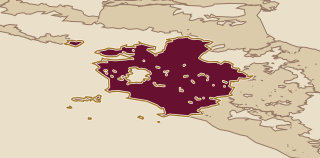
Gaiole in Chianti sits toward the eastern edge and higher elevation of the Chianti Classico zone. The Gaiole UGA is one of eleven Additional Geographical Units that Chianti Classico introduced to allow producers to identify a more specific origin on the label, one step below the zone-wide appellation. A bottle labelled with the Gaiole UGA comes from a cooler, more elevated landscape than the central or southern reaches of Chianti Classico, and the wine behaves accordingly: higher acidity, a longer natural ageing arc, and Sangiovese fruit that tends toward dark cherry and iron rather than the softer, warmer register found at lower elevations.
The estate spreads across four named valleys: Bellavista, San Lorenzo, La Casuccia, and Montebuoni. Vineyards run from roughly 430 to 527 metres above sea level. At that altitude, ripening is slower and the grape holds its acid line through harvest. Wine from these vineyards can develop for a decade or more without losing energy.
In the cellar
Vineyards and cellar
In 1982, Castello di Ama introduced the open-lyre vine training system to Italy. No producer in the country had used it before. The system shapes the vine canopy into a V-shaped form that increases the surface area exposed to light and air. At altitude, where ripening can be marginal in cooler years, the open lyre raises sugar accumulation and reduces the risk of fungal disease in a dense canopy. Grafting and retraining roughly 50,000 vines took the better part of five years. The technique is now widely used across Tuscany.
Fermentation takes place in stainless steel with temperature control. Ageing uses a combination of large botte and smaller barrique. The flagship San Lorenzo Gran Selezione spends at least 30 months in barrel and bottle combined before release, as required under Gran Selezione rules. New oak accounts for a smaller share than it once did: the current approach favours the oak-neutral large cask, which allows slow oxygen exchange without adding wood flavour.
Wines to know
The range in view
Castello di Ama produces three tiers under the Chianti Classico appellation. The entry-level Chianti Classico annata blends fruit from across the estate's parcels and is released youngest. The Riserva draws from selected older vines or superior blocks and receives longer ageing before release. Both are Sangiovese-dominant.
San Lorenzo Gran Selezione is the flagship. Gran Selezione is the top classification under Chianti Classico rules, requiring a minimum of 30 months of ageing and selection from the estate's finest vineyards. San Lorenzo draws from all four estate valleys, Bellavista, San Lorenzo, La Casuccia, and Montebuoni, making it a multi-valley assemblage rather than a single-vineyard wine. The 2022 blend is 80% Sangiovese, 13% Merlot, and 7% Malvasia Nera. The Merlot adds mid-palate weight; the Malvasia Nera contributes aromatic lift. Dark fruit, firm acidity, and a tannic spine built for the long term characterise the wine across vintages.
A useful way in
A bottle to begin with
Start with San Lorenzo Gran Selezione. It is the wine in which every decision the estate has made becomes audible at once: the altitude of Gaiole, the multi-valley assemblage, the open-lyre canopy work, the reduced new oak, and the minimum 30 months of ageing that Gran Selezione rules require. In the glass it shows dark fruit, a savoury mineral line, and firm-but-ripe tannins with the acidity to age. It is not a soft or approachable wine in the obvious sense, but it is an honest and complete one. Open it with food and return to it across a long evening; the wine changes as it breathes.