
Why it matters
The producer
Castello di Corbara sits in the Umbrian hills between Orvieto and Todi, a corridor where two appellations meet a medieval castle and one family has spent decades arguing for grapes most of the region was happy to overlook. The estate covers 1,000 hectares, with 100 planted to vines, and operates across the Orvieto Classico DOC and the Lago di Corbara DOC entirely within its boundaries.
Fernando Patrizi has led the estate since 2008. He first joined the management in 1998, when his father Livio died suddenly and Fernando stepped in alongside his mother and sisters to keep the winemaking and hospitality work going. That early period shaped the direction: the estate had already committed to sustainability that year and had just supported the creation of a new appellation built on a grape most producers had not bothered to document. Fernando eventually took full charge, and the twin-appellation, twin-biotype model has been the estate's signature since.
Place and vineyards
Where the wines begin
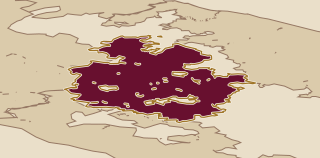
Orvieto is one of Umbria's oldest wine towns, and the Classico zone, the original and most tightly defined part of its DOC, climbs the volcanic hills south of the town. Castello di Corbara sits within that older zone, which entitles it to add Classico to its Orvieto labels, a distinction that separates the estate's whites from the broader DOC territory that expanded outward over decades.
A few kilometres south, the Lago di Corbara basin opens up around a reservoir on the Tiber. The Lago di Corbara DOC covers this territory and applies to the estate's red wines. The appellation is small and not widely known outside central Italy. Corbara supported its establishment in 1997 and the appellation now gives the estate's Sangiovese a legal home that the grape would otherwise have lacked.
In the cellar
Vineyards and cellar
Harvesting happens during the cooler hours of the day. In a warm inland climate, bringing fruit in before the heat builds reduces the risk of oxidation and early fermentation before the grapes reach the cellar.
Grapes are vinified separately by variety and vineyard origin. The final blends are assembled shortly before bottling, which gives the winemaking team a longer window to assess each component before committing to a blend. The effect in the glass is wines where the individual grape character comes through clearly rather than being resolved into a single neutral profile.
Wines to know
The range in view
The white range is built on Grechetto. The estate maintains its own Grechetto biotype, which it considers distinct from standard regional Grechetto, and uses it both in Orvieto Classico blends and as a varietal bottling.
Piana Grande is the estate's Orvieto Classico Superiore, a blend of indigenous grapes led by Grechetto, vinified by vineyard parcel and variety, assembled shortly before bottling. The Superiore designation means the wine has a higher minimum alcohol requirement and a longer production path than basic Orvieto Classico. Falstaff reviewed the 2022 vintage.
A useful way in
A bottle to begin with
Piana Grande is the first bottle. It is an Orvieto Classico Superiore from the estate's own Grechetto biotype, blended with other indigenous white varieties, vinified parcel by parcel and assembled before bottling. In the glass it shows the aromatic personality of Grechetto grown on volcanic soils: white fruit, almonds, a clean herbal note, and the bright acidity. The texture is light to medium, the finish dry and focused. It gives a clear account of what the estate does with its most carefully maintained grape on its most distinguished white wine appellation.