
Why it matters
The producer
Tommaso was born in 1988 and represents the new generation at Castello Tricerchi, where he plays a pivotal role in the company. The estate's Sangiovese Grosso vineyards produce Brunello di Montalcino and Rosso di Montalcino. The red range uses one grape variety across two Montalcino appellations.
In 1800, Maddalena passed the castle and its property to her eldest son Julio Squarcia, an ancestor of the present family. That handover sits inside an older Tricerchi history: by 1290, the family belonged to Siena's Government of Nine, and the building on the Via Francigena was completed in 1441. Italy recognised Tricerchi Castle as part of the country's historical and artistic heritage in 1982. The former dungeons now house the wine cellars, where thick walls and air chambers above and below keep the temperature constant throughout the year.
Place and vineyards
Where the wines begin
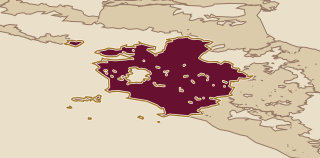
Montalcino's northern slopes are the estate's geographic setting. The Sangiovese Grosso vineyards supply both Brunello di Montalcino and Rosso di Montalcino, so the two appellation wines share one grape source.
The vineyard soils contain limestone clay and sand and are rich and even. The vines face north almost exclusively, which allows uniform ripening. For a red grape, uniform ripening lets fruit, acidity and tannin develop together before harvest.
In the cellar
Vineyards and cellar
Castello Tricerchi hand selects its grapes. Local yeasts carry the fermentations, and long periods of skin maceration leave the fermenting wine in contact with grape skins for extended time, extracting colour and tannin. Maturation follows traditional methods in Slavonian durmast barrels. Oak ageing softens tannin and adds gentle spice as the wine develops.
Wines to know
The range in view
Castello Tricerchi makes two red Montalcino appellation wines, Brunello di Montalcino and Rosso di Montalcino, from Sangiovese Grosso. Rosso receives at least nine months in 20 hectolitre Slavonian casks and at least four months in bottle, with further development possible. Brunello comes from the same Sangiovese Grosso vineyard base, so the range holds its grape source constant while the appellation name changes.
Brunello shares the Sangiovese Grosso vineyard base. In the Rosso, that grape appears as strawberry, cherry jam, light spice, flowers and mineral notes. The palate is intense and balanced, with dense tannins and a long savoury mineral finish.