
Why it matters
The producer
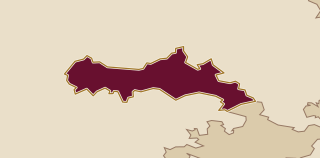
Cave Mont Blanc de Morgex et La Salle is a cooperative of about 80 growers working the highest commercial vineyards in Europe. Its cellars sit at La Ruine in Morgex, at the foot of Mont Blanc, and its vineyards occupy both Morgex and La Salle, two municipalities in the Valdigne, the uppermost wine-growing sub-zone of Valle d'Aosta in northwestern Italy. Everything the cooperative produces is white, still or sparkling, and every bottle comes from a single grape: Prié Blanc.
The cooperative was constituted in 1983, succeeding the Association des Viticulteurs, a growers' association whose formation was encouraged in part by Don Bougeat, the parish priest of Morgex until 1971. From that growers' movement the cooperative grew, expanded its membership through its first decade, and eventually pushed its vinification work higher than anyone had gone before, running fermentation experiments above 2,000 metres with local mountain guides from 2003 onward. By 2015 the cooperative had formalised that work with a permanent winery at 2,173 metres.
Place and vineyards
Where the wines begin
The Dora Baltea river runs down from the Mont Blanc massif through Valle d'Aosta toward Piedmont. In the Valdigne, its uppermost reach, the valley walls are steep and the climate is cold, dry, and continental. The vineyards of Morgex and La Salle occupy the orographic left bank, climbing in terraced steps to 1,200 metres. That altitude matters in a specific, practical way: phylloxera, the root louse that forced most of Europe's vineyards onto grafted American rootstocks after the 1870s, cannot survive here. The Valdigne sits above the louse's viable range.
The consequence is that every vine in the Blanc de Morgex et de La Salle denomination grows on its own European roots. The denomination name itself contains both place names: Morgex and La Salle are not just the postal addresses of the growers but the legal boundaries of a DOC built around a single grape at a single extreme altitude. Above these terraces, commercial viticulture in Italy stops.
In the cellar
Vineyards and cellar
Prié Blanc in the Valdigne is propagated by layering. A shoot from the mother plant is buried in spring while still attached, and severed the following season once it has developed its own roots. The practice is ancient and slow. It means the cooperative's vineyards are planted with vines that trace their rootstock back through local generations, without grafting onto American material.
For still wines, fermentation takes place in stainless steel tanks with indigenous yeasts under temperature control. The wine is racked without clarification or stabilization and bottled to order, so each batch arrives fresh rather than sitting in inventory with fining or sterile filtration applied. For Glacier, the traditional-method sparkling wine, the first fermentation uses both large Alpine larch-oak vessels and stainless steel tanks before the wine goes into bottle for its second fermentation. It then ages on the lees for 30 months before disgorgement. No dosage liqueur is added at disgorgement: Glacier is released as Pas Dosé, completely dry.
Wines to know
The range in view
The cooperative's range is narrow by design: the denomination permits only Prié Blanc, and the cooperative makes only Blanc de Morgex et de La Salle in its still and sparkling forms.
The still Blanc de Morgex et de La Salle is the foundation. Fermented in steel with indigenous yeasts and bottled without fining or stabilization, it is light-bodied, pale straw in colour, and keyed to freshness rather than weight. The absence of clarification and the bottled-to-order approach mean the wine arrives with the kind of live texture that processing would strip away. Acidity is high, fruit is clean and unadorned, and the finish is short and mineral. At this altitude and with this grape, concentration is not the point: the wine is a precise record of a cold growing season.
A useful way in
A bottle to begin with
Glacier Pas Dosé is the bottle to start with. It is a traditional-method sparkling wine made entirely from ungrafted Prié Blanc grown at up to 1,200 metres, fermented first in larch-oak vessels and steel tanks, then aged on the lees for 30 months before disgorgement with no dosage added. What arrives in the glass is completely dry, with high acidity, fine persistent mousse, and a mineral, flinty close. The biscuit note from the lees ageing sits quietly behind the fruit without softening the wine's essential dryness. Start here and the still wine, when you return to it, reads as the same philosophy at lower speed.