
Why it matters
The producer
Xavier and Cristina Bernet farm seven hectares of calcareous hillside in the Ordal Massif and turn those grapes into sparkling wine under a label named for their first daughter, Júlia. Almost everything they produce is Brut Nature: no dosage, no sweetness adjustment, no borrowed grapes. The estate sits at roughly 400 metres, which is high enough in Penedès terms to hold acidity naturally through a warm summer and hand the cellar a wine that does not need topping up at disgorgement.
They belong to Corpinnat, a collective of Penedès producers who resigned from the Cava denominació in 2018 to build a label governed by stricter rules on origin, farming and ageing. Júlia Bernet was already doing most of what Corpinnat requires before the collective existed. No pesticides, no herbicides, horsetail herb against mildew, sheep compost from a nearby farm, indigenous yeast fermentation. Joining Corpinnat formalised what the estate had already chosen.
Place and vineyards
Where the wines begin
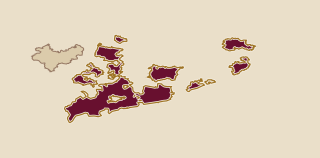
The Ordal is a limestone hill range that rises between the Penedès plain and the coast, roughly halfway between Barcelona and Tarragona. On the valley floor, the Penedès is warm and productive. At 400 metres on calcareous terrain, it is cooler, rockier, and better for sparkling wine grapes that need to hold their acidity into harvest.
Corpinnat carries the appellation consequence here. A bottle labelled Cava can draw on grapes from several Spanish regions, aged for as little as nine months. A Corpinnat bottle comes from a defined part of Catalonia, from estate grapes, and is aged for a minimum period determined by the collective's rules. The Ordal address narrows things further: this hillside, this soil, these specific parcels, harvested by hand.
In the cellar
Vineyards and cellar
The seven hectares are divided into small plots and harvested entirely by hand. Organic farming means no synthetic pesticides or herbicides; the estate uses horsetail herb, a traditional mildew treatment, and fertilises with sheep compost sourced from a local farm. These choices slow production but preserve the soil's biology and keep the vine roots working.
In the cellar, fermentation runs on indigenous yeasts without inoculation, which means slower, less predictable ferments that tend to produce more complex, less uniform results. Sulphite use is minimal. The sparkling wines go through traditional-method secondary fermentation in bottle. Across the range, no dosage is added at disgorgement: Brut Nature throughout. Whatever acidity, texture and fruit character the vineyards and fermentation produce arrives in the glass unmodified.
Wines to know
The range in view
The range divides into six Brut Nature sparkling wines and four still wines, all from estate grapes. The sparkling wines carry Corpinnat classification; the still wines sit in the broader Penedès appellation by geography.
Maria Silver is the best-documented bottle in the range: a Corpinnat Brut Nature made from Xarel-lo, a white grape native to Catalonia that is one of the classic varieties behind traditional Penedès sparkling wine. Xarel-lo at this altitude gives a wine with firm acidity, some weight in the mid-palate, and a dry, almost saline finish. Because there is no dosage, the texture comes entirely from the grape, the lees contact, and the vintage character rather than from sweetness added after disgorgement.
A useful way in
A bottle to begin with
Maria Silver, Corpinnat Brut Nature, is the place to start. It is a single-variety Xarel-lo sparkling wine from the estate's Ordal hillside parcels, made without dosage and aged in bottle through traditional-method secondary fermentation. In the glass it is dry and mineral, with firm acidity, lemon pith and white stone fruit on the nose, a textured mid-palate from lees ageing, and a long, clean, saline finish. No sweetness, no oak, no correction. Start here and the whole estate becomes legible: the altitude, the organic farming, the Corpinnat standards, the Brut Nature commitment across the range.