
Why it matters
The producer
The Andreu family has farmed vineyards in Conca de Barberà since the 18th century. Carles Andreu, heir to that long farming line, founded the estate winery bearing his name in 1991 and converted Cal Celdoni, a stone manor house dated to 1759, into its first working cellar. The old fermentation vats stayed in place for the first bottles.
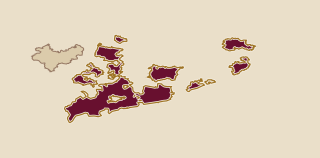
The winery sits in Pira, a small agricultural village in Tarragona province, about ten kilometres west of Montblanc, the main town of the denomination. D.O. Cava registers the estate as an integral producer with organic production: every bottle comes from the family's own 80 hectares, spread across Pira, Forès, Sarral, Solivella, Barberà de la Conca, and Montblanc. The range runs from zero-dosage white cavas to a Trepat rosé, built on the three varieties most closely identified with the Conca de Barberà landscape.
Place and vineyards
Where the wines begin
Conca de Barberà is an inland Catalan appellation in Tarragona province, cooler and drier than the coastal wine zones. The continental climate, with warm days and cold nights during the growing season, slows ripening and preserves acidity in the grapes. That acidity is what gives Parellada and Macabeu their particular usefulness in cava, where freshness and a clean finish matter more than weight.
The denomination is one of the permitted production zones for D.O. Cava. Celler Carles Andreu holds integral producer status under both frameworks: D.O. Conca de Barberà for its still wines and D.O. Cava for its sparkling production. The label on a bottle of Carles Andreu cava reflects this dual registration, and the distinction matters because integral producer status means every grape in every bottle was grown on the estate's own parcels, not sourced from co-operatives or third-party growers.
In the cellar
Vineyards and cellar
All 80 hectares are farmed organically, without purchased fruit. The spread across six municipalities gives the estate access to different aspects and elevations within the denomination, though the winery uses this to grow its core varieties across the range rather than to make single-vineyard wines.
Parellada, Macabeu, and Trepat make up the bulk of the plantings. Xarel-Lo appears in the Reserva Brut Nature blend alongside Parellada and Macabeo. In the cellar, the standard white cavas follow the conventional cava method: secondary fermentation in bottle, extended lees ageing, and disgorgement before release. The Reserva Barrica breaks from that pattern by fermenting in new French oak barrels before bottle ageing, adding a layer of toasted grain and softness that the tank-fermented wines do not carry. Zero dosage on the Barrica means no corrective sweetness: the wine relies on its Parellada fruit and the oak influence alone.
Wines to know
The range in view
The range divides clearly into three bottles, each built on a different stylistic decision.
The Reserva Brut Nature blends Parellada, Macabeo, and Xarel-Lo with no dosage. Bottle-aged and dry, it runs toward apple, fresh herbs, and a lean acid finish. The zero-dosage commitment means no added sugar at disgorgement; what you taste is the blended fruit and the lees character accumulated during bottle ageing.
A useful way in
A bottle to begin with
Start with the Reserva Brut Nature: Parellada, Macabeo, and Xarel-Lo, zero dosage, bottle-aged. It is the clearest expression of what Conca de Barberà's inland cool-climate Parellada tastes like in sparkling form: dry, fresh, apple-forward, with a clean herb note and a tight acid finish. No dosage sweetness, no oak, no interference. The mousse is moderate rather than aggressive. It is a cava made to taste of its grapes and place rather than to fill a category expectation, and it gives an honest account of what the estate's 80 hectares produce.