
Why it matters
The producer
Pep Aguilar and Patri Morillo run Celler Comunica from Mas d'en Cosme, a granite-soiled estate in Falset, within the D.O. Montsant appellation in Catalonia. The project is built around a deliberate premise: that granite, in Montsant, produces a particular kind of wine, and that farming the right parcels carefully enough is how you get there. Aguilar and Morillo say they spend more time in the vineyards than in the winery. The range is short and direct. Both main wines come to the bottle unfined, unfiltered, and without any oak contact.
The grapes are red Grenache, downy Grenache, Carignan, and a small planting of Syrah. Farming is organic across the estate. The wines carry no classification beyond the D.O. Montsant designation, but the site and the cellar approach tell the story more plainly than any hierarchy would.
Place and vineyards
Where the wines begin
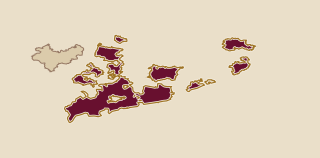
Falset is the main town and administrative centre of the D.O. Montsant appellation, a circular zone that surrounds the better-known D.O.Q. Priorat without overlapping it. Montsant covers a wide range of soils and elevations across the Priorat comarca, from lower limestone and clay ground to higher granite and schist parcels. Falset itself sits at the heart of the appellation, and the Mas d'en Cosme estate lies between the Baboixos and Fontanals areas of the village, with views toward the Mola de Colldejou ridge.
In the cellar
Vineyards and cellar
All farming at Mas d'en Cosme is organic. The vines are harvested by hand. For Suc de Sauló, the main wine, maceration and fermentation take place in basket-style vessels over 12 to 18 days, followed by basket pressing. The wine then ages on its fine lees in stainless steel for 22 months before bottling, unfined and unfiltered. The lees contact adds texture and a faint savouriness to the mid-palate without adding any of the vanilla or wood tannin that barrel ageing brings.
Vi del Mas follows a shorter path: eight months on fine lees in stainless steel, then bottling unfined, unfiltered, and without oak. The process is the same in principle, compressed in time, producing a lighter, earlier-drinking bottle.
Wines to know
The range in view
The range at Celler Comunica is compact. Two wines form the core; a third appears as a limited release.
Suc de Sauló is the main red. It draws on organically farmed vines between 25 and 70 years old, planted on granite at 370 metres. After hand harvest and basket pressing, it ages for 22 months on fine lees in stainless steel. The extended lees contact gives the wine a textured mid-palate, while the granite site and the absence of oak keep the acidity bright and the fruit character clean. Garnatxa Negra and Garnatxa Peluda are the backbone grapes, with Carignan contributing darker fruit, firmer tannin, and grip on the finish.
A useful way in
A bottle to begin with
Suc de Sauló is the bottle to begin with. It is a red wine from old vines on granite at 370 metres, aged 22 months on fine lees in stainless steel, and bottled unfined and unfiltered. The palate is textured rather than heavy: fresh acidity, fine tannin, a mineral mid-palate, and a finish that carries the Carignan's grip long after the fruit has faded. No oak has touched it. Start here to understand what Aguilar and Morillo are building at Mas d'en Cosme, what granite produces in Montsant, and what two years on lees does when no barrel is involved.