
Why it matters
The producer
Celler de Capçanes sits in the village of Capçanes, inside DO Montsant, the appellation that encircles the more famous Priorat in southern Catalonia. It is a cooperative, founded in 1933 by five families, and it operates from the village itself. That is the ordinary part.
The unusual part is that in 1995 this small Catalan village cooperative, with no Jewish investors and no Jewish residents, became the producer of one of Spain's first modern kosher wines. The request came from Barcelona's Jewish community. The cooperative said yes, bought dedicated fermentation tanks that could never revert to standard production, and launched Peraj Ha'abib. The tanks are still in use. The kosher line has run unbroken for thirty years.
Place and vineyards
Where the wines begin
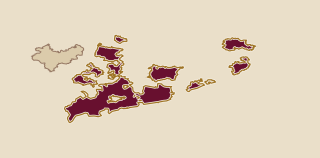
Montsant is not Priorat, and that distinction matters for the label and the price. Priorat occupies a tight, dramatically steep core; Montsant wraps around it as a broader ring appellation, sharing the altitude and the indigenous red varieties but covering more varied terrain and typically yielding wines at more accessible prices. Both appellations lie in the province of Tarragona, in the far south of Catalonia, where the Mediterranean climate is tempered by altitude and mountain shelter.
Part of the vineyard area holds organic certification, though a precise certified-hectare figure is not confirmed across sources.
In the cellar
Vineyards and cellar
Garnacha Negra and Cariñena are the core varieties, both grown as bush vines, a training system that forces each plant to support itself without wire or trellis. Bush vines in the Montsant hills typically yield less fruit per vine than trellised equivalents, and the oldest plants at Capçanes are around 110 years old. At that age the root systems are deep and extensive, yields are very low, and the fruit tends to concentrate sugars and flavour compounds more than younger vines on the same soil.
The additional variety roster covers Tempranillo, Merlot, Cabernet Sauvignon, Syrah, and Pinot Noir for reds, and Macabeo and Garnacha Blanca for whites. The altitude range of 250 to 550 metres means parcels at the top of the estate ripen later and carry more natural acidity than lower plots.
Wines to know
The range in view
The range divides into three groups.
The kosher range centres on Peraj Ha'abib, the founding bottled label, with the name translating from Hebrew as Flower of Spring. Below it sits Peraj Petita in two colours. Peraj Petita Negre is a five-grape blend of Merlot, Syrah, Tempranillo, Grenache, and Carignan: red-fruited and approachable, with the Carignan and Grenache adding the herbal, iron-inflected character of Montsant's old vine plots. Peraj Petita Blanc is built on Macabeo with lees treatment that adds body and breadth to a grape that can otherwise run thin.
A useful way in
A bottle to begin with
Start with Peraj Petita Negre. It is the most widely exported wine in the range, the most clearly documented, and the most direct expression of what this cooperative farms. The five-grape blend puts Garnacha Negra and Cariñena in context alongside the international varieties the estate also grows, and the kosher production protocol means the wine carries the full story of what makes Capçanes different from other Montsant cooperatives. In the glass: dark cherry, dried rosemary, a touch of iron from the slate soils, firm mid-palate tannin, and enough acidity from the altitude to keep the finish clean and direct. Drink it with lamb or cured meat.