
Why it matters
The producer
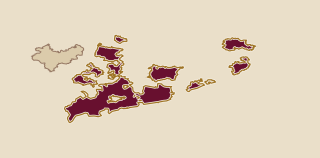
Celler de Sanui holds a position no other winery shares: it is the only estate registered under the Costers del Segre denomination of origin within the municipal boundaries of Lleida city. The estate occupies the Partida de Torres de Sanui, a named locality on Lleida's western edge reached via the old Cerdera road, and its vineyards form a single unbroken block of more than ten hectares. That physical coherence, one estate, one continuous piece of ground, shapes everything about how the range is built.
The Lleida location matters because Costers del Segre is not a compact appellation. It stretches across a broad inland swath of Catalonia through Lleida province and into parts of Tarragona, covering a semi-arid continental landscape where summers are hot and dry but nights cool sharply. Those diurnal swings keep acidity alive in grapes that might otherwise flatten in the heat. Celler de Sanui sits at the city end of this territory, closer to the provincial capital than to the more remote sub-zones of the denomination.
Place and vineyards
Where the wines begin
Costers del Segre is an appellation shaped by drought-adapted viticulture. The continental climate produces hot, dry summers with low humidity and little rainfall during the growing season, conditions that demand careful water management and reward grape varieties that can hold freshness under heat. The strong difference between daytime and night-time temperatures, common across this inland Catalan territory, slows ripening in the final weeks before harvest.
The Torres de Sanui estate sits on calcareous-clay soils described as semi-deep with good mineral composition. Calcareous soils, meaning soils with a meaningful limestone content, moderate vine vigour and slow water uptake in ways that concentrate flavour in the grape without forcing the vine into stress. The clay fraction retains enough moisture to see vines through dry summers without irrigation supplements. These two soil qualities, the limestone skeleton and the clay body, explain why the reds hold freshness despite the warmth of the growing season.
In the cellar
Vineyards and cellar
The single contiguous vineyard block simplifies farming decisions: one soil type, one microclimate, one harvest window to manage across the whole estate. Calcareous-clay soils in a semi-arid continental climate require careful management of vine water status, particularly in August when temperatures peak. The soil's clay component provides a natural buffer.
In the cellar, the two tiers reflect different approaches. El Petit de Sanui Negre is made for early drinking: a Tempranillo, Syrah and Merlot blend assembled for red-fruit accessibility, medium body and the kind of fresh tannins that do not demand years of cellaring. The Merlot softens the blend; the Syrah pushes the peppery, darker-fruited element that runs through the palate and finish.
Wines to know
The range in view
El Petit de Sanui Negre is the entry point: Tempranillo, Syrah and Merlot in a fruit-led, medium-bodied red. The 2021 vintage opened with red plum and blackberry, with pepper, menthol, liquorice and a touch of bramble leaf in the aromatic register. The palate brought candied strawberry, red plum and raspberry, with fresh acidity and rounded tannins. The finish persists with pepper. An earlier 2019 bottling, labelled Al Petit de Sanui, showed a lighter, more volatile profile: tart cherry, green pepper and paint on the nose, dry and fruity in the mouth with lively acidity and soft tannins. The two vintages together show a wine built for early drinking across a range of fruit weights.
Prat d'Hores Negre sits alongside the Blanco as a barrel-aged red, with more complex wood handling than the everyday Petit line.
A useful way in
A bottle to begin with
Start with Prat d'Hores Blanco. It is the wine where the estate's ambitions and its unusual grape choices are most legible: a Lleida-grown Macabeo-Riesling-Muscat blend, ten months in French oak, dry and full on the palate. The 2019 vintage showed ripe stone fruit and pear framed by caramel and toast, broad through the mid-palate and persistent on the finish. The Riesling is not decorative; at thirty percent it holds the wine's acidity against the oak weight, keeping the texture interesting rather than merely rich. Order it with roast pork or aged sheep's cheese and the weight makes sense immediately.