
Why it matters
The producer
Château de Saint Cosme is the label for the Barruol family's estate grown Gigondas wines. Saint Cosme names the négociant wines made from contracted growers across Southern and Northern Rhône appellations. The distinction separates vineyard ownership from purchased fruit on the front of the bottle.
Wine production at the property is documented from 1416. The Barruol family acquired the estate in 1570 and built a residence over existing cellars. Its range now includes estate grown Gigondas, négociant wines, and Château de Rouanne in Vinsobres, acquired in 2019.
Place and vineyards
Where the wines begin
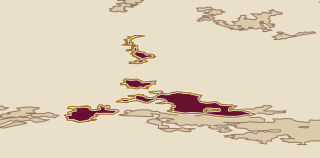
Gigondas supplies the estate's home appellation, while the négociant operation reaches across the Southern and Northern Rhône. That division gives the labels different geographic roles: Château de Saint Cosme identifies estate grown Gigondas, while Saint Cosme covers wines made from contracted fruit.
The Vinsobres holdings appear under the separate Château de Rouanne label. Château de Rouanne remains a distinct producer in the same Barruol family, with its wines tied to the Vinsobres appellation rather than Gigondas.
In the cellar
Vineyards and cellar
Organic farming began under Henri Barruol in the 1970s, and full biodynamic certification followed in 2010. Fermentations use native yeasts and whole clusters. Whole cluster fermentation leaves the stems with the grapes, which can add perfume, spice, and tannin during fermentation.
Estate wines are bottled unfined and unfiltered. Fining removes some suspended material, while filtration clarifies the wine before bottling. Leaving out both steps preserves more of the wine's original suspended matter.
Wines to know
The range in view
The estate grown Gigondas range includes three single vineyard cuvées: Hominis Fides, Le Poste, and Le Claux. Hominis Fides and Le Poste were introduced in 2003, followed by Le Claux in 2004.
Saint Cosme Côtes du Rhône 2023 is the négociant line's 100% Syrah bottling. Les Deux Albion 2021 combines Syrah, Grenache, Carignan, Mourvèdre, and Clairette, with whole clusters co fermented in wooden and concrete vats. Château de Rouanne Vinsobres is aged in cement vats for 16 months and contains 1.4 grams per litre of residual sugar.
A useful way in
A bottle to begin with
Choose Saint Cosme Côtes du Rhône 2023. It is the 100% Syrah wine from the négociant line, carrying the Saint Cosme name rather than Château de Saint Cosme and the Côtes du Rhône appellation rather than a named Gigondas vineyard.