
Why it matters
The producer
In 1983, Suntory acquired Château Lagrange from the Cendoya family when only 56 hectares remained. The estate later expanded its planted vineyard from 48 to 138 hectares under director Marcel Ducasse between 1993 and 2007. That recovery still shapes the wines: a Cabernet led Grand Vin from higher gravelly slopes sits beside a second wine drawn from lesser soils.
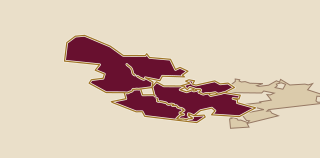
Château Lagrange belongs to the Saint-Julien appellation and was classified as a Third Growth in 1855. The name therefore joins a formal Bordeaux category to a very physical address, where slope, gravel and parcel selection decide which fruit reaches each bottle.
Place and vineyards
Where the wines begin
Saint-Julien is a Bordeaux appellation whose wines are built around red grapes, with Cabernet Sauvignon at the centre of Château Lagrange's blends. The estate's higher slopes carry gravel, while sand and clay appear elsewhere across the vineyard. Cabernet Sauvignon from the gravelly upper ground supplies the Grand Vin with blackcurrant fruit and firm tannin, while fruit from lesser soils takes a different place in the range.
The label wording follows that geography. Château Lagrange names the Grand Vin, while Les Fiefs de Lagrange identifies the second wine. Both come from the same estate, but their vineyard sources give them different roles.
In the cellar
Vineyards and cellar
The 103-parcel vineyard allows fruit to be separated by the ground beneath it. Higher gravelly slopes supply much of the Grand Vin, while vines on lesser soils generally provide fruit for Les Fiefs de Lagrange. The distinction appears in the bottle as a difference in range role, not simply a second label.
The wines also need time to show their balance. Young vintages benefit from two to three hours in a decanter, which softens their powerful tannin. Mature bottles become increasingly supple and refined as that tannin settles with age.
Wines to know
The range in view
Château Lagrange is the Cabernet Sauvignon led Grand Vin of the estate. The 2019 blend contains 80 percent Cabernet Sauvignon, 18 percent Merlot and 2 percent Petit Verdot. It is full-bodied and fleshy, with black fruit, cassis, morello cherry, cigar box and tobacco, held by tannins that combine power with a velvety feel.
The 2021 pushes Cabernet Sauvignon further, with 84 percent of the blend alongside 14 percent Merlot and 2 percent Petit Verdot. Dark berries, blackcurrant, pencil shavings, licorice and loamy soil sit over youthful, powdery tannin and lively acidity.
A useful way in
A bottle to begin with
Château Lagrange 2020 is the bottle to open first. It is the estate's medium-bodied Grand Vin, drawn largely from higher gravelly slopes and led by Cabernet Sauvignon. Crème de cassis and plum rise first, followed by violet, licorice, pencil shavings and vanilla. The palate brings redcurrant jelly, ripe blackcurrant and minted blackberry before dark chocolate and star anise appear.