
Why it matters
The producer
The estate began in 1792, after Château de Pez was divided and sold following the French Revolution. Its buildings and long address give the wine a fixed place in northern Saint-Estèphe, while the bottle itself belongs to the red Bordeaux tradition of blending several grapes rather than presenting one variety alone.
The Cazes family acquired Château Les Ormes de Pez in 1940. The same family owns Château Lynch-Bages in Pauillac and Domaine des Sénéchaux in Châteauneuf-du-Pape, but Ormes de Pez remains a Saint-Estèphe wine with its own blend and cellar decisions. Annual production is approximately 18,000 cases, enough for the estate to make a recognisable house style across a substantial volume without losing the named château on the label.
Place and vineyards
Where the wines begin
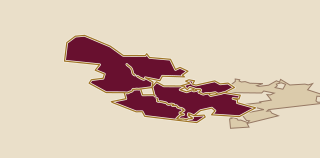
Pez is a hamlet in the Médoc, and Château Les Ormes de Pez sits in the northern part of the Saint-Estèphe appellation. Saint-Estèphe is the legal place name on the bottle, while Médoc supplies the wider Bordeaux setting. That wording tells you to expect a red made from Bordeaux grapes, with the vintage and blend completing the label's information.
The 2021 wine shows how that place is expressed through composition. Merlot accounts for 49 percent, Cabernet Sauvignon 40 percent, Cabernet Franc 6 percent and Petit Verdot 5 percent. Merlot has the largest share, but Cabernet Sauvignon remains substantial, so the wine is built from both generous fruit and the firmer frame associated with a Cabernet-led Bordeaux blend.
In the cellar
Vineyards and cellar
Approximately 18,000 cases leave the vineyard each year. Grapes ferment and macerate for around 20 days in temperature-controlled stainless steel vats, giving the fruit a defined period of extraction before it moves into barrel. The cellar sequence is easy to follow: stainless steel for fermentation and maceration, then French oak for maturation.
The oak recipe has become more substantial since 2000. The earlier average of 10 percent new French oak contrasts with the later level of about 50 percent for close to 15 months. In 2021, the wine spent 16 months in French oak with 45 percent new wood. The finished wine carries rounded tannins, abundant fruit, extract and chewy mineral tones, with the cellar method supporting a fuller, more layered profile.
Wines to know
The range in view
The range centres on one named red, Château Les Ormes de Pez Saint-Estèphe. The 2021 blend gives the bottle a clear internal order: Merlot leads, Cabernet Sauvignon follows closely, and Cabernet Franc and Petit Verdot complete the composition in smaller amounts. The colour is deep garnet, while the recorded profile brings fresh cherry, black fruit, layers of flavour, rounded tannins, lingering freshness, substantial extract and chewy mineral tones.
Recent vintages have a full-throttle character, with plenty of flavour rather than a light, quick-drinking profile. That language fits the combination of fruit layers, extract and firm but rounded tannins. The wine is usually best enjoyed within the first 10 to 20 years after the vintage, a window that suits its concentration while allowing time for the tannins and fruit to knit together.
A useful way in
A bottle to begin with
Start with Château Les Ormes de Pez 2021. It is a Merlot-led Saint-Estèphe red made from the four Bordeaux grapes, fermented and macerated for around 20 days in temperature-controlled stainless steel before 16 months in French oak, with 45 percent new wood. In the glass, it brings deep garnet colour, fresh cherry, black fruit, rounded tannins, extract and a mineral-toned finish.