
Why it matters
The producer
Sémillon and Sauvignon Gris make the estate's white wine, alongside a Saint Estèphe red grand vin built from Merlot and Cabernet Sauvignon. Château Tronquoy Lalande spans 30 hectares, holds Cru Bourgeois classification, and received 100% organic certification in 2024. Its grand vin production is approximately 7,500 cases annually.
The estate's origins date back to the 18th century. The Casteja family owned the property from 1968 until Martin and Olivier Bouygues acquired it in 2006. After the acquisition, they brought Jean Bernard Delmas out of retirement to manage both Château Montrose and Château Tronquoy Lalande. Delmas had previously served as director of Château Haut Brion for decades. In 2022, the property shortened its name to Château Tronquoy and modernised its label art.
Place and vineyards
Where the wines begin
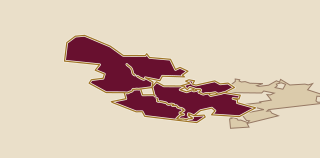
The vineyard lies in the heart of the Saint Estèphe appellation in Bordeaux. The red grand vin carries the Saint Estèphe address, while the white wine is listed as Bordeaux Blanc.
Since 2011, one hectare on the upper part of the plateau has been set aside for white wine production. The parcel adds a white vineyard programme to an estate otherwise centred on a Saint Estèphe red range.
Wines to know
The range in view
The red grand vin combines Merlot and Cabernet Sauvignon with touches of Petit Verdot and Cabernet Franc. Merlot and Cabernet Sauvignon bring fruit and power, while Petit Verdot and Cabernet Franc add freshness, refinement and aromatic complexity.
Château Tronquoy Lalande Blanc is made from Sémillon and Sauvignon Gris. The grapes are harvested by hand in small open crates during successive sweeps. Vinification takes place in barrels, followed by lees maturation for six to nine months. Lees ageing keeps fine yeast solids in contact with the wine, a method that can add texture during maturation. Individual parcels are fermented in 22 geothermal powered stainless steel tanks.