
Why it matters
The producer
Chiusa Grande is a family-owned organic estate in Abruzzo, central Italy, farming vineyards across three separate sites in the Pescara hills and beyond. The D'Eusanio family have been growing vines since the early 1960s, when founder Rocco D'Eusanio built a nursery business supplying other growers across central and southern Italy. In 1991 the family bought the Chiusa Grande country estate and turned that trade knowledge inward, beginning organic conversion immediately and releasing their first wine five years later. The estate is now led by Franco D'Eusanio and his children Ilaria and Rocco.
The bottle that travels is Tommolo Montepulciano d'Abruzzo: a single-variety organic red reviewed independently by Decanter and Falstaff and sold across 25 countries. That export reach is unusual for an estate of this size and reflects a long commitment to organic certification at a time when Italian producers were still debating its commercial logic.
Place and vineyards
Where the wines begin
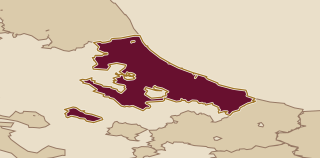
Abruzzo runs down the central Adriatic side of the Italian peninsula, sheltered from Atlantic weather by the Gran Sasso and Maiella ranges. The Pescara hills, where Chiusa Grande's Nocciano winery sits, occupy the middle band of the region at 200 to 250 metres above sea level. At this elevation, warm summer days and cool nights preserve acidity in both white and red varieties, giving Montepulciano d'Abruzzo the freshness to age without the heaviness it can show at lower, hotter sites.
Montepulciano d'Abruzzo is the region's defining red appellation, named for the grape rather than the Tuscan town and built entirely on the variety's thick-skinned, deeply coloured fruit. Its DOC rules govern minimum alcohol, yield and ageing requirements, but they leave considerable room for producers to choose between early-drinking, fruit-forward styles and more structured, extended-ageing wines. Chiusa Grande's Tommolo sits in the fruit-forward, accessible end of that range.
In the cellar
Vineyards and cellar
Chiusa Grande farms without chemical herbicides. Fertilisation relies on organic material, particularly manure, working in the logic that soil health rather than foliar intervention sets fruit quality over the long term. AIAB certification sets the permitted sulphite ceiling at below 80 mg/l for whites and below 60 mg/l for reds, lower than the EU organic wine standard. Five wines are produced without any added sulphites, with total sulphur dioxide below 10 mg/l.
In the cellar, the estate uses must hyperoxygenation before alcoholic fermentation. The technique, developed in the 1970s, deliberately oxidises the most reactive compounds in freshly crushed must, so that the finished wine is more stable against oxygen exposure during and after bottling. All wines, including young vintage releases, go through malolactic fermentation, which converts sharp malic acid to softer lactic acid and contributes a rounder mid-palate across the range.
Wines to know
The range in view
The Tommolo label is Chiusa Grande's main market line. Tommolo Montepulciano d'Abruzzo is a single-variety organic red from fruit grown at Nocciano and Cugnoli. The 2023 vintage received 89 points from Falstaff. The 2021 Decanter review confirmed the wine as a structured Montepulciano with a drinking window extending to at least 2027, showing that the low-sulphite, malolactic-fermented approach produces fruit capable of short-term ageing rather than only immediate drinking. Tommolo also extends to a Chardonnay from the Nocciano site.
A second label, In Petra, covers wines macerated in sandstone vats from Pietranico, a village in the Pescara hills. Sandstone is a porous material that allows slow micro-oxygenation during maceration without imparting oak flavour, producing wines with softer tannins and a rounder texture than barrel-aged equivalents.
A useful way in
A bottle to begin with
Start with Tommolo Montepulciano d'Abruzzo. It is a single-variety DOC red from certified organic Montepulciano fruit grown at Nocciano and Cugnoli, fermented with full malolactic conversion and bottled at sulphite levels well below the EU organic ceiling. The wine gives dark cherry fruit, firm grape tannin and a clean, slightly earthy finish. It carries enough acidity to work with food and enough fruit concentration to drink on its own. The 2023 vintage holds 89 Falstaff points; the 2021 was judged structured enough to drink through 2027. This is the bottle that shows what Chiusa Grande does: organic farming at low sulphite levels, producing Montepulciano with genuine character rather than processed softness.