
Why it matters
The producer
Ciacci Piccolomini d'Aragona sits inside an eighteenth-century castle at Castelnuovo d'Abate, a hamlet at the southern end of the Montalcino appellation in Tuscany. The estate grows Sangiovese on more than 30 hectares of its own land, farms organically without seeking certification, and makes Brunello di Montalcino as its core wine. Every bottle comes from estate-grown grapes.
The family running it has no noble blood. Lucia and Paolo Bianchini, along with their respective families, make the wine, tend the olive groves, and keep bees on the property. They inherited everything from a countess who had no children and chose her foreman instead.
Place and vineyards
Where the wines begin
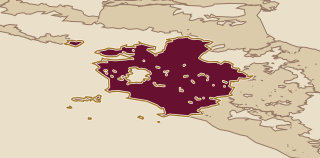
Montalcino is a hilltop town in the Val d'Orcia, south of Siena. The Brunello di Montalcino DOCG covers vineyards in all directions around the town, but the southern sub-zones, including Castelnuovo d'Abate, differ from the cooler northern and eastern slopes in a practical way: warmer afternoon sun, earlier ripening, and a fruit profile that tends toward generosity rather than austerity.
That southerly warmth is legible in the wines. The estate Brunello carries ripe red fruit and soft tannins, a profile coherent with the Castelnuovo d'Abate position. Brunello di Montalcino DOCG requires 100% Sangiovese and mandates extended oak ageing before release, so every bottle from this estate comes from one grape on one approved appellation, aged in wood before it reaches the market.
In the cellar
Vineyards and cellar
Fermentation takes place in lined cement and stainless-steel tanks, with temperature control used to manage extraction. After fermentation, the wines move to wood: maturation runs from 12 months for shorter-cycle wines up to 48 months for Brunello, primarily in large Slavonian-oak botti. A small number of barriques sit alongside them.
The botti choice matters for how the wine is built. Large-format Slavonian oak gives slow, diffuse oxygen contact over a long ageing period, softening tannin without imposing the vanilla or coconut character that smaller new French oak would add. The result in the glass, as described by the estate, is soft tannin and a long finish, consistent with the method. The estate Brunello then receives additional bottle refinement before release.
Wines to know
The range in view
The range has three clear tiers, all built on Sangiovese.
Rosso di Montalcino DOC is the estate's younger release, fermented the same way as the Brunello but aged for a shorter period in lighter oak. Cherry, red fruit, violet and gentle spice are the estate's own descriptors. It drinks from release and gives access to the Castelnuovo d'Abate fruit without the wait Brunello requires.
A useful way in
A bottle to begin with
Start with Brunello di Montalcino DOCG, the annual estate release. It is 100% Sangiovese from Castelnuovo d'Abate, fermented in temperature-controlled vats, then aged in large Slavonian-oak botti for up to 48 months before bottle refinement and release. Red-berried and floral on the nose, warm and full in the mouth, with soft tannins and a clean long finish. No new oak character, no structural severity. It is a Brunello from the warmer southern flank of the appellation, built traditionally, and it explains the cellar method and the place in one bottle. Pianrosso, when available, goes further, but the estate Brunello is where the house logic is clearest.