
Why it matters
The producer
The Ciavolich family has been making wine in Abruzzo since 1853, but the estate now at work in the province of Pescara carries a longer history behind it. The family traces back to Bulgarian wool merchants who fled the advance of the Saracens and settled in Miglianico, in the province of Chieti, around 1560. Three centuries later, Francesco Ciavolich built the family's first winery directly opposite his home in Miglianico, processing grapes from the surrounding land. That underground cellar ran continuously until December 1943.
The production heart today is Contrada Salmacina at Loreto Aprutino, where the farmstead and winery sit inside a block of 35 hectares of vineyards, three of olive groves, and ten of arable land. A second property at Pianella adds fifteen hectares, six planted to Montepulciano d'Abruzzo and one to Pecorino, both trained to pergola Abruzzese. The two estates together offer Ciavolich an address spread across inland Abruzzo, farming the region's principal grape varieties alongside the indigenous Cococciola, a white grape seldom found outside the Chieti and Pescara zones.
Place and vineyards
Where the wines begin
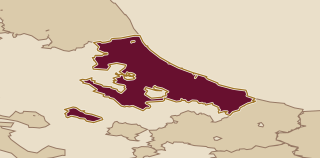
Loreto Aprutino sits inland in the province of Pescara, on elevated terrain between the Gran Sasso massif to the west and the Adriatic coast to the east. The position matters to the wines. Nights here are cooler than on the coastal plain, which extends the growing season for Montepulciano d'Abruzzo and preserves acidity in the white grapes. The Masseria del Vino farmstead catches the thermal shift between mountain air and sea breeze across the full ripening arc.
Montepulciano d'Abruzzo is Abruzzo's most important red grape appellation, covering the whole region, and it is the anchor of both Ciavolich properties. Trebbiano d'Abruzzo covers the broad base of white wine production in the zone. Cococciola, aromatic and indigenous to this part of central Italy, and Pecorino, a mountain-origin white of high natural acidity grown natively in the Apennine foothills of Abruzzo and the Marche, give the estate's white range something the larger regional producers do not routinely offer.
In the cellar
Vineyards and cellar
The 35 Loreto Aprutino hectares divide evenly: half planted to pergola Abruzzese trained from massal selection cuttings, half to Guyot trained from clonal selection. Pergola Abruzzese is the traditional regional training system, with the canopy extended horizontally to shade the grapes from afternoon heat, moderating ripeness and preserving freshness. Massal selection, drawing cuttings from the best-performing old vines on the estate rather than from certified nursery clones, is the route the estate uses to maintain genetic diversity in the older half of the vineyard.
In the cellar, terracotta amphorae serve two roles: fermentation and ageing. The material is permeable, allowing slow micro-oxygenation without introducing the aromatic compounds that oak transfers to wine. Oak casks of 225, 500, and 1,500 litres are used in the same spirit, as permeable containers for gradual stabilisation rather than as flavour sources. Stainless steel handles wines where freshness and reductive protection matter. Concrete rounds out the toolkit, used for both fermentation and maturation.
Wines to know
The range in view
Ciavolich operates two range identities that use the same vineyards and cellar but make different choices about fermentation and vessel.
The main range draws on the full cellar material. Montepulciano d'Abruzzo from both properties is the red backbone, a grape with deep colour, firm tannin, and dark fruit when grown on inland Abruzzese clay at elevation. The whites from Trebbiano d'Abruzzo and Cococciola work with the freshness that the cooler inland nights preserve: Trebbiano tends toward body and length, Cococciola toward aromatic definition and lighter acidity.
A useful way in
A bottle to begin with
Fosso Cancelli Pecorino is the right first bottle. Pecorino is a mountain grape native to the Apennine foothills of Abruzzo and the Marche, and at Ciavolich it is grown on the Colline Pescaresi hillsides and fermented spontaneously in wood. The wine has real grip: mouth-watering acidity, stone fruit, a creamy middle, and a dry, mineral close. It shows what the estate does in the cellar more clearly than any other wine in the range, because the terracotta and oak fermentation and the lack of cultured yeasts are written into the texture and the finish. It is also the bottle that sets Ciavolich apart from mainstream Abruzzo most cleanly.