
Why it matters
The producer
The name says where the estate stands: Col d'Orcia, the hill overlooking the Orcia River, which runs along the southwestern edge of the Brunello di Montalcino zone. The property sits below the hilltop village of Sant'Angelo in Colle, at the far southwestern limit of the DOCG, with 144 hectares of vine across a 540-hectare holding that also covers Mediterranean shrubland, forest, farro fields, olive groves, and a honey operation.
The Cinzano family bought the estate in 1973, when it was already old: founded around 1890 as Fattoria di Sant'Angelo in Colle, renamed Col d'Orcia around 1958. Count Francesco Marone Cinzano has led it in the decades since. The scale is unusual for Montalcino, where most serious producers farm far smaller parcels. Col d'Orcia uses that scale to hold a library of more than 50,000 bottles, with vintages reaching back to 1962.
Place and vineyards
Where the wines begin
Brunello di Montalcino is a DOCG appellation built around the hilltop town of Montalcino in the province of Siena, south of Chianti and north of the Orcia River valley. Every bottle in the range carries the Montalcino name and is made exclusively from Sangiovese Grosso, the local name for the Brunello clone of Sangiovese.
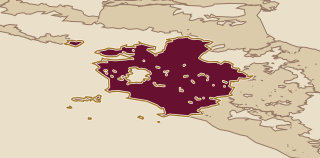
Col d'Orcia occupies the southwestern quadrant of this zone. The Orcia River, which defines the appellation's southwestern boundary, is close enough to give the estate its name. The southwestern position tends to produce wines that ripen a little warmer than those from the northern and eastern sectors of Montalcino, which sit higher and cooler. The vineyard slopes face across the river valley, with long afternoon sun and, on the Poggio al Vento parcel, consistent wind that moderates the heat and extends the growing season.
In the cellar
Vineyards and cellar
All vineyard work is done by hand where possible. Planting, pruning, leaf thinning, green harvesting, and bunch selection are performed manually. The organic farming programme covers every hectare of the estate, not only the wine parcels, which means the olive groves, farro fields, and gardens are farmed to the same standard as the vines.
In the cellar, Col d'Orcia uses very large wooden casks exclusively for its Brunello wines: vessels of 2,500, 7,500, and 15,000 litres in Slavonian and Allier oak. These sizes are traditional for classicist Brunello production. At that volume, the wine-to-wood contact ratio is low, which means the oak contributes oxygen and slow micro-oxidation over a long aging period without adding toasty or vanilla character to the finished wine. The 2021 standard Brunello was aged 30 months in these casks before release. No barriques appear in the traditional Brunello range.
Wines to know
The range in view
The range is built around Sangiovese Grosso and the Brunello di Montalcino DOCG, with two Rosso di Montalcino wines as younger, earlier-drinking alternatives at the base.
The two Rosso di Montalcino bottlings come from younger vines and shorter aging. They give access to the Sangiovese Grosso character of the estate at lower cost and without the cellaring demand of a full Brunello. Expect the tannic grip and high acidity of the grape, but in a lighter, fruitier frame.
A useful way in
A bottle to begin with
Start with the Brunello di Montalcino. It is the main estate wine, 100 percent Sangiovese Grosso, organically farmed, aged 30 months in large Slavonian and Allier oak, and representative of what the southwestern Montalcino position produces under the classical large-wood method. The fruit is ripe and red-toned, the herbs are present throughout, the tannin is firm but not dry, and the acid line extends the finish. It costs less than the single-vineyard Brunellos and requires less patience than the Riservas, but it carries the same house philosophy in every glass. Buy it young and give it three to five years, or open it at ten and see what the cellar has done.