
Why it matters
The producer
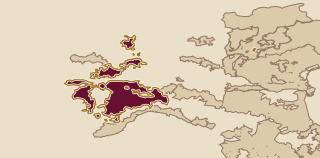
Antonio Colombo spent his career as a cardiologist in Varese. In the early 2000s he chose a hill in Bubbio, in the Asti province of southern Piemonte, and built a wine estate with his children on ten contiguous hectares in Alta Langa. The project turned on a hypothesis: that these high southern Langhe hillsides, where marl and limestone meet sharp thermal swings, could produce Pinot Nero with the acidity and aromatic clarity the variety demands. When the family walked the Bubbio property for the first time, the hypothesis already had evidence. Pinot Nero vines more than eighty years old were growing in the ground, planted, the estate believes, in the nineteenth century.
The estate trades under the name Cascina Pastori. Riccardo Cotarella joined the project in 2010. Vinification focuses on purity and respect for the grape, with ageing mainly in large oak casks and tonneaux.
Place and vineyards
Where the wines begin
Alta Langa is a collective name for the high-altitude southern extension of the Langhe hills, running through parts of Asti and Cuneo. Bubbio sits within it at elevations well above the valley floor. The Alta Langa DOCG, which formally covers traditional-method sparkling wines made from Pinot Nero and Chardonnay, is one of the youngest DOCG zones in Piemonte, and its vineyards typically sit above 250 metres, often higher.
What altitude changes for Pinot Nero is the harvest window. Cooler nights slow ripening and pull temperatures down after warm days, so the grape holds more acidity and more of its aromatic compounds than it would lower down the Langhe slope. The result, in a cellar that does not cover those characters with heavy oak or extended maceration, is a lighter-bodied red with more lift and a more defined aromatic register than most Piemonte Pinot Nero.
In the cellar
Vineyards and cellar
The estate monitors Pinot Nero closely through the growing season and harvests when the grape reaches what it describes as the balance point between roundness and acidity. That moment determines the character of every wine: pick too early and the tannins are sharp; pick too late and the acidity that defines the Alta Langa style is lost.
In the cellar, vinification is kept close to the grape. Cotarella and the family do not aim to build weight or add woody extraction. Ageing for the still Pinot Nero occurs mainly in large oak casks and tonneaux, vessels that allow slow oxygen contact and gentle integration without pressing oak flavour into the wine. The Piemonte DOC Pinot Nero spends approximately one year in stainless steel, which preserves fruit and acidity, then passes through several months of bottle ageing before release.
Wines to know
The range in view
The range divides cleanly into still and sparkling.
The Piemonte DOC Pinot Nero, labelled in its top cuvee as Apertura Maxima, is 100% Pinot Nero from the Bubbio vineyards. A year in stainless steel keeps the wine fresh and transparent; the tannins are gentle and the acidity is the defining structural feature. On the nose it shows redcurrant, sour cherry, dog rose and violet alongside herbal and balsamic notes. In the mouth, cinnamon and white pepper appear alongside the fruit, and the finish is persistent enough that the wine can develop further in bottle. The Apertura Maxima drew 93 points from Wine Enthusiast in 2015 for its 2011 vintage, which showed mature berry, leather, savoury herbs and cooking spice with firm tannins.
A useful way in
A bottle to begin with
Start with the Piemonte DOC Pinot Nero, or the Apertura Maxima cuvee if you can find it. It is the clearest statement of what this estate does: Pinot Nero from eighty-year-old vines on marl and limestone, fermented in stainless steel to keep the fruit and acidity forward, then aged gently before release. The tannins are light, the body is medium, and the aromatics sit in the precise redcurrant-and-violet register that Alta Langa altitude produces. It is not a heavy wine and does not pretend to be.