
Why it matters
The producer
In 2009, Francesco walked away from a previous career and, with his wife Adriana, founded Corte Canella at Via Canella 14 in Illasi, a village in the province of Verona. The name of the address became the name of the estate. Four years later, their daughter Gloria joined the project.
Francesco works the vineyards. Adriana runs the tasting room and wine shop. Gloria spans the cellar, the office, and the communications work that takes the estate outward. The division is neat and total: three people, three distinct jobs, one farm.
Place and vineyards
Where the wines begin
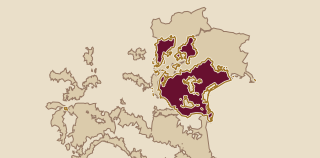
Illasi sits in the Val d'Illasi, a broad, eastward-running valley in the province of Verona. It falls within the wider Valpolicella production zone, specifically in the area known as Valpolicella Allargata, the extended zone that encompasses the valleys east of the historic Valpolicella Classica heartland.
Corte Canella's vineyards are on the hilly Cellore slopes above the valley floor, at around 200 metres above sea level. That elevation matters for Amarone: grapes destined for appassimento spend 90 to 100 days drying after harvest, and the cooler nights at altitude help preserve the acidity that keeps a wine of this weight from tipping into heaviness. The valley itself is described as wide and sunny, which pushes ripeness; the hillside position corrects for that warmth.
In the cellar
Vineyards and cellar
All hand selection takes place in the vineyard. Only the best grapes from each plot are committed to further processing; the rest are diverted at that point.
For Amarone, selected grapes undergo appassimento: a partial dehydration lasting 90 to 100 days. During this time, the grapes lose moisture and concentrate their sugars, dried-fruit character, and phenolic compounds. Fermentation then runs under temperature control for 20 to 25 days, long enough for the elevated sugar load to convert without rushing the extraction.
Wines to know
The range in view
Corte Canella makes six wines. At the top of the range sits the Amarone della Valpolicella DOCG, built from Corvina, Corvinone, Rondinella, and Croatina. This is a full-bodied, deeply coloured dry red with the concentrated dried-fruit character that comes from three months of appassimento before fermentation. The long barrique ageing adds body and a warm spiced undertone, while the producer's philosophy keeps the oak from overwhelming the fruit.
Below the Amarone sits the Valpolicella DOC Superiore, which also involves some drying of the grapes before vinification and receives barrel and bottle ageing. It is a step between the entry-level Valpolicella and the full Amarone: more body and complexity than the basic DOC, without the full intensity of the DOCG.
A useful way in
A bottle to begin with
Corte Canella Amarone della Valpolicella DOCG is the wine around which the entire farm is organised, and it is made from the estate's selected fruit. Corvina, Corvinone, Rondinella, and Croatina from the Cellore hillside vineyards, hand-selected, dried for 90 to 100 days, fermented slowly under temperature control, then aged for 24 months in barrique and two years in bottle. The wine is a deep, concentrated dry red with dried cherry, fig, warm spice, and a firm tannic backbone that needs time. Start here to understand what the Val d'Illasi hillside produces and what the Corte Canella cellar does with it.