
Why it matters
The producer
Cortijo Los Aguilares is a certified organic estate in the Serranía de Ronda, the mountain range that rises behind the ancient cliff-top city of Ronda in Andalusia. José Antonio Itarte established it in 1999, planting bush vines on clay and limestone at high altitude in a zone where commercial winemaking had been largely absent for over a century. Bibi García leads the technical work.
The estate farms six grape varieties, an unusually international selection for southern Spain: Pinot Noir, Petit Verdot, Tempranillo, Grenache, Syrah, and Cabernet Sauvignon. The Pinot Noir attracted the sharpest outside attention, winning Great Gold at the Mondial du Pinot Noir in Sierre, Switzerland in 2008 and Gold in 2010, results that the Grandes Pagos de España, the quality association the estate belongs to, described as highly unusual for a Spanish wine of that variety. The flagship red is Pago El Espino, a Petit Verdot-led blend aged in French oak. Tinto CLA is the unoaked counterpart, built around Tempranillo and stabilised in concrete.
Place and vineyards
Where the wines begin
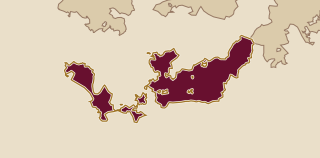
The Serranía de Ronda sits in the western corner of Andalusia, far from the sherry country of Jerez and the coastal warmth of Málaga. Altitude is the defining condition: the mountain vineyards sit high enough that summer heat is moderated by cool nights, and the marked diurnal temperature difference slows ripening and preserves acidity in a region where low-elevation fruit would otherwise cook through. Winter rainfall is generous. The estate sits within reach of both the Mediterranean to the east and the Atlantic to the west, a geographical double influence that shapes the growing season without belonging squarely to either maritime zone.
That altitude carries a consequence beyond freshness. UV radiation intensifies at elevation, and the grape most sensitive to it, Pinot Noir, risks scorching before it can ripen. The decision to grow it here was not cautious. That it produced award-winning wine is what turned the estate's location from a curiosity into a statement.
In the cellar
Vineyards and cellar
All fruit comes from the estate's own certified organic bush vines. No synthetic herbicides, pesticides, or fertilisers are used across the 30 hectares. Bush vine training at low planting density limits yields and concentrates flavour in each berry.
The two wines in the current range follow entirely different cellar routes. Pago El Espino spends 15 months in French oak barrels after fermentation, a period long enough to soften Petit Verdot's naturally firm tannin, integrate colour, and build the toasted and spiced register that oak élevage of that duration produces. Tinto CLA bypasses oak entirely: after fermentation it goes into concrete tanks for a four-month stabilisation. Concrete neither adds flavour nor strips it; it allows slow, stable oxygen exchange without the vanilla, cedar, or toast that wood contributes. Tinto CLA stays close to fresh red fruit and wild fennel.
Wines to know
The range in view
Pago El Espino is the estate's principal statement. The 2024 vintage blends 72% Petit Verdot with 16% Syrah and 12% Tempranillo, an unusual composition for Spain. Petit Verdot is almost always a minority component in Bordeaux-influenced blends, used for colour and grip but rarely given lead position. At nearly three-quarters of the blend, it drives the wine's dark fruit concentration, firm tannic frame, and depth of colour. Syrah adds a darker, slightly peppery register; Tempranillo softens the mid-palate. Fifteen months in French oak barrels builds the toasted and balsamic layer that sits over the ripe fruit on the nose, and carries into a long, smooth finish.
The estate's Pinot Noir, which earned the international medal recognition, is not detailed in the current range beyond its award record. Six organic varieties are under cultivation, suggesting a broader range than these two bottles alone.
A useful way in
A bottle to begin with
Pago El Espino is the bottle that shows what the estate is doing at altitude with French oak and an unusual lead grape. Petit Verdot at 72% of the blend is a commitment: this is not a Bordeaux grape used for colour adjustment but the primary structural and flavour driver. The 15 months in French oak add a toasted and balsamic layer that lifts the ripe dark fruit without masking the mountain freshness underneath. The palate is smooth, the tannin firm and rounded, and the finish long.