
Why it matters
The producer
In 1963, more than 650 Penedès winegrowers decided to stop selling grapes separately and make wine together. Covides Vinyes-Cellers was the result: a cooperative that now unites over 700 active member families across approximately 2,000 hectares of vineyards spread across more than 50 rural settlements in the Penedès. It is the sixth-largest Cava DO producer in the designation and the largest cooperative in Catalonia by volume for premium wine.
Covides owns every one of those hectares outright and sources its entire harvest from its own land. Three wineries handle production: one in Sant Sadurní d'Anoia, the historic capital of Cava; one in Sant Cugat Sesgarrigues; one in Vilafranca del Penedès. Together they process a harvest that feeds exports to more than 50 countries, with international sales representing nearly 65 percent of total turnover.
Place and vineyards
Where the wines begin
The Penedès is the broad agricultural plain and hill country that runs inland from the Catalonian coast south of Barcelona. The Cava DO, which governs the method and minimum aging requirements for Spanish traditional-method sparkling wine, draws most of its volume from this region. Sant Sadurní d'Anoia sits at the heart of it, a town that has produced bottle-fermented sparkling wine since the mid-nineteenth century.
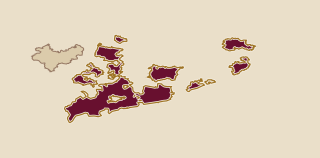
The Covides vineyards sit across a wide arc of Penedès terrain rather than on a single slope or valley. At this scale, approximately 2,000 hectares across more than 50 settlements, the vine holdings span different elevations, aspects, and soil types. What unifies them is cooperative ownership and a shared commitment to the three traditional Cava grapes: Xarel·lo, Macabeu, and Parellada. Chardonnay enters at the premium tier, where its weight and texture complement the Xarel·lo and Parellada in the Duc de Foix range.
In the cellar
Vineyards and cellar
Sixty percent of Covides vineyard land uses pheromone dispensers to disrupt the mating cycle of Lobesia botrana, the grape berry moth whose larvae damage fruit before harvest. The approach reduces pesticide applications and preserves predator insect populations in the vineyard. Over 300 hectares carry full organic certification, meaning no synthetic inputs across the growing cycle.
In the cellar, Covides combines traditional Cava method with modern temperature control and sorting. Second fermentation takes place in bottle, as the Cava DO requires. The Casteller range ages for a minimum period; the Xènius Brut Selección ages in the Sant Sadurní d'Anoia cellars; the Duc de Foix Brut Nature Reserva stays on its lees for more than 15 months before disgorgement. Brut Nature means no dosage is added after disgorgement, so the wine's character depends entirely on what the grapes and the aging produced rather than on residual sweetness added at the end.
Wines to know
The range in view
The range runs across three brands, each aimed at a different moment and price point.
Casteller is the entry range, named after the castellers, the teams who build human towers at Catalan festivals. The name references cooperative effort directly: many people stacked into something that holds together. Composition details for Casteller Brut have not been confirmed from accessible sources.
A useful way in
A bottle to begin with
The Duc de Foix Brut Nature Reserva is the right starting point. It is a blend of Xarel·lo, Parellada, and Chardonnay from the cooperative's best-selected plots, aged on its lees for more than 15 months and finished with no dosage. The mousse is fine and steady. The nose has toasted almond, lemon, and white fruit. The palate is taut and dry, with a chalky thread running through to a clean, lean finish. It is not a party Cava; it is a food Cava, serious enough to accompany shellfish, salt-cured fish, or a plate of Ibérico.