
Why it matters
The producer
Jean-Claude Martin came from Switzerland and chose a ridgeline above Walker Bay that most South African producers had passed over. The Hemel-en-Aarde Ridge sits higher and cooler than the valley floor below it, catching ocean winds off Walker Bay that slow ripening and compress the growing window into something closer to a northern European rhythm. Martin founded the estate with his partner Carolyn Martin, and the two flagship grapes have never changed: Chardonnay and Pinot Noir, both shaped by the particular combination of altitude, maritime air and clay soils the ridge provides.
Creation is not a Burgundy imitation. The grape choices echo that region, but the winemaking decisions and the site are South African. The Pinot Noir style has shifted in a traceable direction over the estate's history, moving away from riper, more extracted early vintages toward the fresher, more mineral profile the wine carries now. That shift was made deliberately, through a change in cellar practice, and it is audible in the glass.
Place and vineyards
Where the wines begin
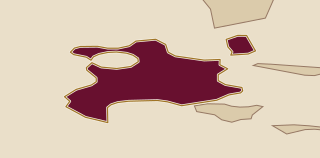
Walker Bay is a coastal appellation in the Western Cape, roughly two hours east of Cape Town. The Hemel-en-Aarde Ridge is a sub-zone that rises above the Hemel-en-Aarde Valley floor and faces the cold South Atlantic. The cool afternoon winds are not incidental: they push daytime temperatures down at exactly the point when Pinot Noir and Chardonnay would otherwise accumulate sugar too fast. A long, even growing season keeps acidity high and allows aromatics to develop before the grapes are harvested.
This is not the warm, powerful South Africa of Stellenbosch or Paarl. Wines from the ridge tend toward lighter colour, tighter fruit and firmer acid than those from warmer inland zones. The label says Walker Bay, and the wine carries the maritime character of that address: cooler, leaner, more aromatic.
In the cellar
Vineyards and cellar
Cool afternoon winds off Walker Bay reduce heat accumulation on the ridge throughout the growing season. This keeps the Pinot Noir canopy from overripening and allows the Chardonnay to develop citrus and stone fruit aromatics before harvest without crossing into tropical registers.
In the cellar, the Reserve Chardonnay 2023 was fermented in a mix of thirty percent new French oak barrels and seventy percent second-fill French oak barrels, then left on the lees for ten months while undergoing full malolactic fermentation. The new oak contributes a warm spice note; the lees time adds texture and rounds the natural acidity without erasing it. Malolactic conversion softens the sharpest edges of the acidity, producing a palate that feels rich but does not feel heavy.
Wines to know
The range in view
The two confirmed range positions are the Reserve Chardonnay and the Reserve Pinot Noir. Both are grown on clay-loam and quartz soils on Hemel-en-Aarde Ridge.
The Reserve Chardonnay 2023 is one hundred percent Chardonnay from quartz-on-clay parcels. Grapefruit, apple and a honey note sit at the aromatic centre, with a warm cinnamon spice from the oak regime underneath. The palate is shaped by lees richness working against the vineyard's natural acidity: the wine feels textured and full without losing the forward citrus that cool-climate Chardonnay produces. Ten months on the lees and full malolactic conversion give the mid-palate density; the oak contributes warmth rather than wood flavour.
A useful way in
A bottle to begin with
Start with the Reserve Chardonnay 2023. It is one hundred percent Chardonnay from quartz-on-clay parcels on the ridge, fermented in thirty percent new and seventy percent second-fill French oak, then rested on lees for ten months with full malolactic fermentation. In the glass: grapefruit and apple at the front, warm cinnamon spice from the oak behind it, then a textured mid-palate from the lees, and a finish that stays fresh because the vineyard acidity was never fully suppressed. The oak is present but measured; the lees give body without weight; the acidity is the frame that holds it together. It is a fair account of what cool-maritime Chardonnay from this ridge can produce.