
Why it matters
The producer
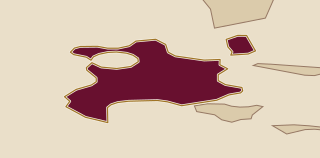
Crystallum Wines is a family winery in the Walker Bay district of the Western Cape, making only Pinot Noir and Chardonnay from cool-climate vineyards across Hemel-en-Aarde and surrounding areas. Andrew Finlayson trained as an architect; his brother Peter-Allan studied philosophy and economics. Neither came through viticulture school, and that absence of habit turned out to matter. Their father Peter was among the first winemakers in South Africa to work seriously with Burgundian varieties, founding Bouchard Finlayson in Hemel-en-Aarde Valley and demonstrating that the region's ocean-cooled air and long growing season could ripen Pinot Noir and Chardonnay without the heat-driven bluntness that marked most South African wine of the era.
Andrew and Peter-Allan started Crystallum in 2007, inheriting an already-proven argument about the region. What they chose to do differently was strip the cellar back: no commercial yeasts, no enzymes at pressing, no sulphur addition at the press, large-format oak rather than new barriques. Peter-Allan handles winemaking. In 2021, Tim Atkin MW named him South African Winemaker of the Year.
Place and vineyards
Where the wines begin
Walker Bay sits on the southwestern tip of the Western Cape, where the Atlantic pushes cold air inland through the Hemel-en-Aarde Valley. The name translates loosely from Afrikaans as heaven and earth, which is useful only as a pointer to the topography: steep, mountain-flanked slopes that funnel ocean wind and keep daytime temperatures low enough for Burgundian varieties to ripen slowly and hold their acidity.
The Clay Shales vineyard on the Hemel-en-Aarde Ridge sits at approximately 300 metres altitude in a mountain shadow, with ocean proximity on two sides. Soils are Bokkeveld shale and clay, a combination that drains freely, retains enough moisture to avoid stress through the dry growing season, and contributes a mineral character to the finished wine. Shale-derived soils in Hemel-en-Aarde tend to produce wines with taut acidity and a chalky texture, and the clay fraction here adds weight to the mid-palate without softening the line.
In the cellar
Vineyards and cellar
Peter Max Pinot Noir is naturally fermented with half the fruit de-stemmed and half left as whole clusters going into the vessel together. The whole-cluster portion contributes a spicy, slightly savoury lift and a firmer tannin line than fully de-stemmed fruit would give. Total skin contact runs four weeks, which for Pinot Noir is a long maceration: it extracts colour, builds tannin, and integrates the whole-cluster character. The wine uses native yeasts throughout.
Clay Shales Chardonnay is whole-bunch pressed with no enzymes, no sulphur, and no commercial yeasts added at pressing. After an overnight rough-settling, the juice goes directly into a single 2,600-litre foudre, a large-format vessel that limits oak contact per unit of wine compared to standard 228-litre Burgundy barriques. The wine ferments with ambient yeasts and ages on lees for ten months inside that foudre. Lees ageing at this duration builds texture and a creamy mid-palate weight. Reduced new oak is used across the range, meaning oak registers as background rather than flavour.
Wines to know
The range in view
Crystallum produces two wines.
Peter Max Pinot Noir is a multi-vineyard red drawing fruit from Walker Bay sites including Hemel-en-Aarde and the inland Elandskloof district. The 50/50 whole-cluster and de-stemmed split and four weeks of skin contact make this a structured Pinot Noir with a darker fruit register: cranberry, pomegranate, blueberry, dark chocolate, and wet-stone acidity on the finish. The tannins are present and need time but the fruit weight carries them.
A useful way in
A bottle to begin with
Start with Clay Shales Chardonnay. It is a single-site wine from a 300-metre altitude parcel on Bokkeveld shale and clay on the Hemel-en-Aarde Ridge, whole-bunch pressed into one large foudre, ambient-fermented, and aged on lees for ten months. No enzymes, no added sulphur at pressing, no commercial yeasts: the wine is what the vineyard and the ambient cellar environment produce. In the glass it gives white pear, lemon, macadamia, and oatmeal breadth, with a mineral acidity that runs from the entry to the finish. Reduced new oak is used across the range.