
Why it matters
The producer
Dacasto Duilio farms 8 hectares in Agliano Terme, a village in the Asti province of southeastern Piemonte. The land has stayed in the same family for five generations. Duilio manages the vineyards, with the wider family supporting cellar work. The range they make is wider than the address suggests: three tiers of Barbera, a Chardonnay tribute to Burgundy, a white variety almost nobody plants in this village, and a traditional-method sparkling wine from high-altitude Piemonte fruit.
The estate's stated aim is to make wine in the simplest and most natural way possible, with grape quality carrying the work. That principle shows in how the range is organised: Barbera anchors everything, and the other grapes sit around it as deliberate departures rather than commercial hedging.
Place and vineyards
Where the wines begin
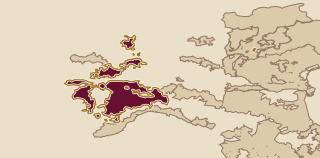
Agliano Terme sits in the Asti province, south of the town of Asti in southeastern Piemonte. The hills here belong to the Monferrato, the broad rolling landscape of clay-rich soils where Barbera has its deepest roots. Agliano is firmly in red-grape territory. The village name appears on Barbera d'Asti DOCG bottles and, for wines from the Nizza sub-zone within Asti, on Nizza DOCG labels, an appellation that carries stricter ripeness thresholds and longer minimum ageing than standard Barbera d'Asti.
North of the Tanaro River, in the Roero, Arneis is the native white grape. Agliano is south of Asti, on the opposite bank, in country where Arneis is rarely planted. That geography matters when the estate describes its Arneis decision as a gamble. The Alta Langa DOCG, where the estate's sparkling wine originates, is a separate appellation entirely: high-altitude sites in Piemonte, governed by traditional-method rules and a minimum of 30 months on lees.
In the cellar
Vineyards and cellar
The estate's 8 hectares carry Barbera as the dominant planting, supplemented by Arneis, Chardonnay, and Pinot Nero. The Arneis vines grow in clay-heavy Agliano Terme ground, conditions that differ materially from the Roero's sandier soils where the grape is more at home. How that translates into the wine is not fully documented, but the estate's description of the planting as worthwhile alongside risky suggests the results validated the choice.
For Barbera, the cellar approach varies by tier. La Maestra, the entry-level Barbera d'Asti DOCG, is built for brightness and early drinking. Camp Riond Barbera d'Asti Superiore undergoes extended ageing in wooden barrels or steel tanks, the choice depending on vintage or cuvée intent; wood ageing adds weight and rounds the grape's natural acidity, while steel preserves freshness and dark fruit. Moncucco Nizza DOCG, the top Barbera tier, must meet the Nizza appellation's minimum ripeness and ageing requirements before release.
Wines to know
The range in view
Three Barbera bottlings form the core of the range. La Maestra Barbera d'Asti DOCG is the entry point: licorice, dark berries, and cinnamon on the nose. Camp Riond Barbera d'Asti Superiore DOCG steps up in weight and complexity, the body fuller and the fruit deeper from extended time in wood or steel. Moncucco Nizza DOCG is 100% Barbera from the Nizza sub-zone, which sits within the Asti province and carries its own DOCG designation with higher minimum requirements than standard Barbera d'Asti; this is where the grape shows most concentrated.
Bourg is a Chardonnay under the broad Piemonte DOC appellation, framed by the estate as a tribute to white Burgundy. The name is direct: "Bourg" pulls from Bourgogne, and the intent is to work with Chardonnay in a way that acknowledges what the grape can do in cooler climates and well-made cellars.
A useful way in
A bottle to begin with
Moncucco Nizza DOCG is the right first bottle. It is 100% Barbera from the Nizza sub-zone, which imposes stricter standards than Barbera d'Asti DOCG and draws out what the grape can do when the site and the appellation both ask more of it. The wine is concentrated, with dark fruit at the centre, firm acidity through the mid-palate, and enough body to hold together over a meal. It is not a light wine. Nizza DOCG as an appellation exists because Barbera from this particular part of Piemonte, when grown and vinified carefully, makes an argument for itself beyond the everyday red it can become at lower quality levels.