
Why it matters
The producer
Jean Smit spent nearly a decade as head winemaker at Boekenhoutskloof, one of South Africa's most internationally distributed houses, before building something with a different logic. Rather than inheriting an estate address and working within it, he set out to argue a case through contrast: the same grape from soils that behave in fundamentally different ways, bottled separately so the difference is audible.
Damascene Winery was founded in 2017 as a collaboration between Smit and entrepreneur David Curl. The project operates from a base in Elgin and sources fruit from contracted growers and parcels across Stellenbosch, Swartland, Franschhoek, the Ceres Plateau, and Cederberg. No vineyards are owned. The range is organised by grape and region of origin, so each bottle carries a specific address rather than blended Western Cape fruit.
Place and vineyards
Where the wines begin
The Western Cape is large and internally varied enough that a single address does not describe the range of climates and soils represented in the wine. Damascene makes that variation the point of the range.
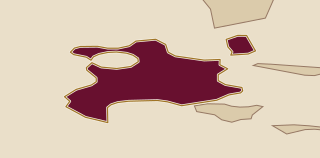
Stellenbosch, the closest of the source regions to Cape Town, sits on ancient granite and contributes a polished, lifted register to Syrah. The Swartland, to the north-west, is warmer and drier, its soils a mix of granite, schist, and Malmesbury shale; Syrah from three parcels there at differing altitudes produces a denser, more muscular fruit profile. The Ceres Plateau, reached by climbing the Witzenberg mountain range into the Bokkeveld, sits above 1000 metres on a completely different soil parent material: shale from the Bokkeveld geological formation, cold, high, and slow-ripening in a way that neither Stellenbosch nor the Swartland can replicate.
In the cellar
Vineyards and cellar
Damascene does not own vineyards. Smit selects specific parcels from contracted growers across multiple regions and farms them to a sustainable standard. The sourcing model means each grape and region combination can be assessed and adjusted over time without being fixed by the geography of owned land.
In the cellar, red wines undergo whole-berry fermentation. No berries are crushed before fermentation begins, which preserves aromatic compounds that crushing would release and oxidise. The wines mature primarily in 2000-litre Austrian foudres, with a small portion in 225-litre French oak barrels. The large foudre is a deliberate choice: at 2000 litres the ratio of wine to wood surface is low, which means the vessel contributes minimal oak character and allows slow oxidative development without adding timber flavour or drying tannins.
Wines to know
The range in view
Syrah is the grape across which Damascene makes its clearest case. The Stellenbosch Syrah and Swartland Syrah are the central bottles: parallel expressions from contrasting soils and climates, made by the same hand in the same cellar, designed to be compared.
The Stellenbosch Syrah 2024 draws from the Polkadraai hill, a Bottelary granite outcrop, and Devon Valley. It is polished and tightly framed, with black fruit purity and aromatic lift over firm, clear-cut tannins. The Swartland Syrah 2024 is the denser wine: slower to open, darker in fruit, with suede-like tannins and a muscular mid-palate that evolves toward roasted black fruit with air.
A useful way in
A bottle to begin with
Start with the Stellenbosch Syrah. It draws from granite and clay soils across the Polkadraai hill, Bottelary, and Devon Valley, fermented whole-berry and matured in 2000-litre Austrian foudres. The nose is lifted and precise: bitter orange, black cherry, aromatic cedar. The palate is tightly framed, with clear-cut tannins, a blackberry and mulberry core, and a finish of clove and crushed black pepper that dries cleanly. No oak dominance, no flattened fruit. It is the most complete picture of what the Damascene cellar does at its most measured, and it sets up the Swartland Syrah as a useful contrast once the house register is established.